
Review: ‘100 Nights of Hero,’ starring Emma Corrin, Nicholas Galitzine, Maika Monroe, Amir El-Masry, Charli XCX, Richard E. Grant and Felicity Jones

December 5, 2025

by Carla Hay

Emma Corrin and Maika Monroe in “100 Nights of Hero” (Photo by Christopher Harris/Independent Film Company)

“100 Nights of Hero”

Directed by Julia Jackman

Culture Representation: Taking place in an unnamed medieval fantasy world, the fantasy comedy/drama film “100 Nights of Hero” (based on the graphic novel “The 100 Nights of Hero”) features a predominantly white cast of characters (with a few black people, Latin people and Asians) representing the working-class, middle-class and wealthy.

Culture Clash: After refusing to have sex with his newlywed wife, her husband makes a bet with a close friend that the friend won’t be able to seduce the wife, who goes through a journey of self-discovery with help from her storytelling maid.

Culture Audience: “100 Nights of Hero” will appeal primarily to people who are fans of the movie’s headliners, the novel on which the movie is based, and unusual movies about gender roles, feminist ideology, and sexual seduction through mind games.

Nicholas Galitzine and Maika Monroe in “100 Nights of Hero” (Photo by Matthew Towers/Independent Film Company)

The dark comedy fantasy “100 Nights of Hero” is a quirky adaptation of Isabel Greenberg’s novel. The movie (about a virginal bride at the center of a sexual competition) is sometimes disjointed, but it’s an intriguing rebuke of misogynistic oppression. The film’s pacing is occasionally dull, but if viewers are still interested in watching the movie about 30 minutes into this 91-minute film, then the movie will keep viewers guessing how the movie is going to end. There’s a big part of the movie’s conclusion that is obvious and telegraphed about halfway through the film, but the rest might be surprising to some viewers.

Written and directed by Julia Jackman, “100 Nights of Hero” had its world premiere at the 2025 Venice International Film Festival and later screened at the 2025 BFI London Film Festival. The movie is based on Greenberg’s 2016 graphic novel “The 100 Nights of Hero,” which has been described as a “feminist fairy tale.” The story takes place in a fictional medieval fantasy world where almost everyone has British accents. “100 Nights of Hero” was filmed on location in the Knebworth area of England.

The movie has intermittent voiceover narration from a narrator (voiced by Felicity Jones) who remains unseen. Jones (who is an executive producer of “100 Nights of Hero”) also has a small acting role as a character named Moon, who’s in the movie for only about five minutes. The first third of “100 Nights of Hero” is when the movie is at its most rushed and jumbled. The movie hits its stride by the middle of the story.

“100 Nights of Hero” begins by showing the wedding of a woman named Agnes (played by Markella Kavenagh) to an unnamed man (played by Cory Peterson) whom Agnes does not want to marry. It’s an arranged marriage in this patriarchal society, where women are not allowed to be educated beyond learning how to speak and doing things such as cooking, cleaning and other duties that will please men. In this society, a woman’s greatest purpose is to marry and become a mother. Male heirs are considered more important than female heirs. There are many societies today that still teach these attitudes.

The movie’s narrator explains how this “100 Nights of Hero” world came into existence. A teenage girl named Kiddo (played by Safia Oakley-Green) created the world, but her domineering father Birdman (played by Richard E. Grant) demanded that the world would have a population of many people made into his image. Birdman literally looks like someone wearing a bird costume, so expect to see many anonymous “bird people” in the movie. Unbeknownst to the guests at Agnes’ wedding, Agnes was already pregnant with a daughter named Hero. The narrator says that Hero “will change the world.”

The movie then fast-forwards 27 years later to a scene taking place at a castle owned by a wealthy lord named Jerome (played by Amir El-Masry), a newlywed who lives there with his virtuous wife Cherry (played by Maika Monroe), who is still a virgin in the beginning of the movie. Jerome and Cherry are having a meeting at a large dining table with Birdman and several other men in the community. Birdman is upset that Cherry still hasn’t become pregnant after six months of marriage to Jerome.

Cherry, who is polite and soft-spoken, is considered Birdman’s “ideal” type of wife. Birdman personally chose Jerome to marry Cherry in this arranged marriage because Jerome promised that Cherry would be able to produce a male heir. Birdman ominously tells Jerome that he has 101 nights to impregnant Cherry, or else Jerome “will not see the next spring.” (Jerome will be killed.) “Now, hurry up and conceive,” Birdman tells Jerome and Cherry in his dismissal comment.

A montage of flashbacks show that ever since the wedding night of Jerome and Cherry, Jerome has come up with excuses to delay having sex with Cherry. Is he impotent? Is he not sexually attracted to Cherry? Is he not sexually attracted to any women? The movie leaves it up to interpretation and never reveals why Jerome is avoiding having sex. Jerome is not overtly cruel to Cherry, but he treats her like an obligation who has made him bored. Cherry is confused but does not complain, like a dutiful wife.

Cherry has an isolated existence. She has all the material things that most people would want. But she has never experienced romantic and passionate love. Her best friend (and only friend) is her maid Hero (played by Emma Corrin), who is very loyal to Cherry. Hero is also very observant and intelligent and knows a lot more than she reveals to most people.

One day, Jerome is visited by a restless and cocky friend named Manfred (played by Nicholas Galitzine), who is a recent widower. Jerome listens as Manfred complains about how Manfred’s deceased wife had been cheating on Manfred before she died. Manfred, who seems to be relieved that his wife dead, is ready to jump back into the playboy bachelor lifestyle that he had before he got married.

Manfred says with some envy that Jerome is very lucky to have a beautiful and doting wife such as Cherry. Jerome lies to Manfred by saying that he and Cherry have a passionate sex life. Jerome has an upcoming business trip and asks Manfred to look after Cherry while Jerome is away. Manfred asks Jerome out loud why he would leave his wife alone with Manfred. “Because I trust you,” Jerome replies.

This leads to Jerome bragging that Cherry would never cheat on him. Manfred, who thinks he’s an expert at seduction, has a hard time believing it. To prove it, Jerome makes a bet with Manfred: Jerome will leave the castle for 100 nights instead of the original plan for Jerome to only be away for only a few nights. And if Manfred can sexually seduce Cherry before Jerome returns to the castle, then Manfred can have the castle. Jerome and Manfred agree to this secret bet.

Jerome tells Cherry that he will be going away on a business trip for a few days, knowing full well that he will be gone for 100 nights. Sometime during his absence, Jerome tells her that he will be away much longer than he expected. While Jerome is away, Manfred schemes up various ways to try to seduce Cherry and gradually develops romantic feelings for her.

Hero sees right through Manfred and becomes a “third wheel” in his seduction manipulation. Hero is often nearby when Manfred would rather be alone with Cherry. Hero begins telling a long story to Cherry and Manfred to keep them entertained. This story becomes a “movie within a movie” in “100 Nights of Hero.”

Hero’s story is essentially about three strong-willed sisters, whose unnamed sea captain father (played by Jeff Mirza) wants all of daughters to become wives and mothers. The three daughters are Rosa (played by Charli XCX), Caterina (played by Olivia D’Lima) and Mina (played by Kerena Jagpal), with Rosa being the most independent-minded of the three. One of the three sisters marries a merchant (played by Tom Stourton) while the sisters hide a big secret that could get them persecuted and executed as witches.

The “movie within a movie” aspects of “100 Nights of Hero” are hit and miss. On the one hand, the story of the three sisters has a certain level of suspense because Hero’s storytelling is constantly being interrupted, so she has to continue the story at other times. On the other hand, these interruptions are often clumsily handled in the movie.

The film also an awkward way handling the timeline for the Hero/Cherry/Manfred part of the story. There are few scenes where Manfred and/or Cherry have lost track of how many days have passed. What they think is a time period of only a few weeks turns out to be several weeks. It’s just the movie’s not-so-clever way of speeding up the timeline.

The most entertaining performances in “100 Nights of Hero” come from Corrin and Galitzine because Hero and Manfred develop an unspoken rivalry for Cherry’s attention and affection. There’s a lively and comedic spark to how Corrin and Galitzine perform in these roles that should keep viewers curious to see what will happen when Manfred tries to be sneaky about his seduction and finds it difficult because Hero always seems to be watching.

The real battle of wits isn’t between Manfred and Cherry. It isn’t between Manfred and Jerome. It’s between Manfred and Hero. (Corrin, Galitzine and Monroe all have executive producer credits for “100 Nights of Hero.”)

Monroe is adequate in her role as Cherry, but she’s the only principal character in “100 Nights of Hero” who has an American accent, which makes Monroe look miscast in a movie that’s supposed to take place in an era that existed centuries before the United States was formed. Grant is barely in the movie; his screen time is less than 10 minutes. And when he’s on screen, he’s behind a bird mask.

Charli XCX, who is best known as a music artist, makes her feature-film acting debut in “100 Nights of Hero,” which features some of her original songs, including “Everything Is Romantic.” Charli XCX’s acting is passably good, but Rosa doesn’t do much in the movie except pout and talk to her family members. In other words, it’s not a difficult role.

The narrative occasionally stalls and gets muddled in “100 Nights of Hero,” but the movie’s cinematography, production design and costume design are visually striking. The costume design is slightly reminiscent of some the wardrobe in “The Handmaid’s Tale” and “Poor Things,” but there’s enough originality in Susie Coulthard’s “100 Nights of Hero” costume design for it to leave a distinct impression.

There’s some brief comic relief in the characters of three security guards (in armor suits) named John (played by Jordan Wallace), David (played by Michael Keough) and Sam (played by Jordan Coluson), who are in the background but occasional bumble and stumble when they see something unexpected. For a movie where sexual seduction is a big part of the story, “100 Nights of Hero” plays it very safe because there are actually no explicit sex scenes or nudity in the film. “100 Nights of Hero” can be considered a love story that isn’t so much about who ends up with whom but about the power of confidently being and loving who you are.

Independent Film Company released “100 Nights of Hero” in U.S. cinemas on December 5, 2025.

Review: ‘All My Friends Hate Me,’ starring Tom Stourton, Charly Clive, Georgina Campbell, Antonia Clarke, Joshua McGuire, Graham Dickson and Christopher Fairbank

April 8, 2022

by Carla Hay
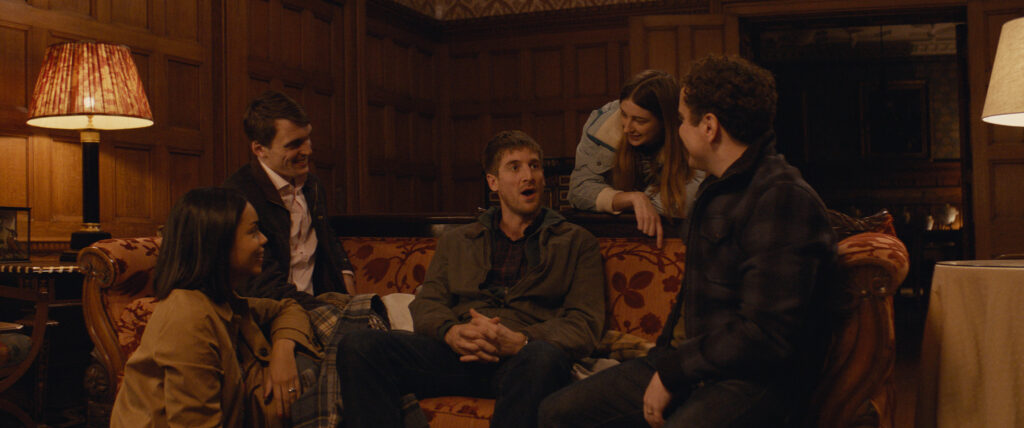
Georgina Campbell, Graham Dickson, Tom Stourton, Antonia Clarke and Joshua McGuire in “All My Friends Hate Me” (Photo by Ben Moulden/Super LTD)

“All My Friends Hate Me”

Directed by Andrew Gaynord

Culture Representation: Taking place in Devon, England, the comedy/drama “All My Friends Hate Me” features a nearly all-white cast of characters (with one black person) representing the working-class, middle-class and wealthy.

Culture Clash: For his 32nd birthday, a man reunites with some of his former college friends at a remote estate in the country, and he is plagued with a nagging suspicion that they are conspiring to make him miserable.

Culture Audience: “All My Friends Hate Me” will appeal primarily to people interested in dark comedies/drama that are intended to keep viewers on edge and feeling uncomfortable.
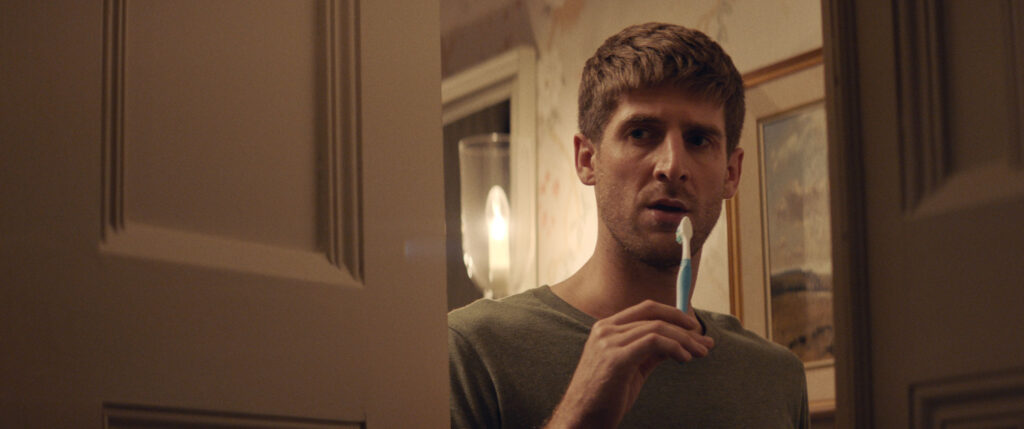
Tom Stourton in “All My Friends Hate Me” (Photo by Ben Moulden/Super LTD)

Deliberately unnerving, “All My Friends Hate Me” taps into people’s insecurities and paranoia that friends can become enemies. Just like the movie’s protagonist, this dark comedy/drama is both fascinating and annoying. The story goes off the rails into incoherence more than a few times, but viewers might remain interested out of curiosity to see how the movie ends.

Directed by Andrew Gaynord, “All My Friends Hate Me” was filmed on location in Devon, England. The movie had its world premiere at the 2021 Tribeca Film Festival in New York City. There’s a very British sensibility to this movie that benefits the story, since British comedy is often about cutting down people who think too highly of themselves.

“All My Friends Hate Me” is told from the perspective of a neurotic man named Pete (played by Tom Stourton), who has a very tension-filled reunion with some of his former college friends for his 32nd birthday. Stourton and Tom Palmer co-wrote the screenplay for “All My Friends Hate Me.” The reunion takes place over a few days, mostly at a place called Cleve Hill Manor, which is in a remote part of the country. The real-life mansion location is actually called Sidbury Manor.

Pete and his university friends come from very privileged backgrounds. For an unnamed period of time, Pete has been working in a refugee camp in an unnamed country. Throughout the movie Pete and his friends show varying levels of elitism, as well as attempts to identify with or interact with less privileged people.

Within these social constructs, Pete feels his own level of discomfort that his friends secretly look down on him because he doesn’t have a high income and spends a lot of time with underprivileged people. However, in the beginning of the movie, Pete is in good spirits, as he travels by himself in his car to the mansion, where his pals have gathered to celebrate his birthday. Pete hasn’t seen these friends in years, but he expects that they will pick up right where they left off, with a lot of good will and positive camaraderie. Pete is about to find out that this assumption is very wrong.

The people who are in this party and who stay overnight at the mansion are:

  • George (played by Joshua McGuire), whose father owns the mansion, but George is the one in the family who spends the most time there, and he oversees the manor’s upkeep. It was George’s idea to throw this birthday party for Pete at the mansion. It’s unclear if George has a profession, but it’s implied that he’s living off of his family’s wealth.
  • Fig (played by Georgina Campbell), George’s wife, who is as status-conscious and self-assured as George is. Fig and George began dating each other when they were in college, and they appear to be happily married.
  • Archie (played by Graham Dickson), a goofy 31-year-old bachelor who is an aspiring entrepreneur. Archie can be socially awkward and has a habit of sometimes saying and doing inappropriate things.
  • Claire (played by Antonia Clarke), an introverted painter artist, who had a fling with Pete when they were in college. Claire was reportedly heartbroken when their would-be romance ended, but she’s decided to stay on friendly terms with Pete.
  • Harry (played by Dustin Demri-Burns), a scruffy and crude 40-year-old country local whom George met at a pub shortly before Pete arrived. George impulsively invited Harry to be a guest at the party after seeing Harry challenging local farmers to rap battles in the pub.
  • Sonia (played by Charly Clive), Pete’s girlfriend, who arrives separately and much later than everyone else at the party. It’s briefly mentioned that Sonia didn’t travel with Pete because of her job commitments.

On his way to the manor, Pete gets lost and asks an elderly man on the road for directions. The man isn’t very friendly and doesn’t seem impressed when Pete says that he’s going to the mansion for his birthday party. Pete is starting to feel anxious because he’s running late.

When Pete arrives at the mansion, he is warmly greeted by friends. When he tells his friends about the strange and unfriendly old man he encountered on the road, Pete is embarrassed to see that the man is standing behind him. His name is Norman (played by Christopher Fairbank), and he’s one of the mansion’s servants. Norman isn’t in the movie much, but his employee role is mostly being a butler.

Not long after Pete arrives for this party, Archie tells Pete that George’s birthday party invitation was a joke. Pete believes Archie, until Archie laughs and confesses that the real joke is that Archie was telling a lie about the party invitation being a prank. It’s the start of Pete feeling unnerved by not knowing what might be sarcastic jokes from the people at this gathering, or what might be genuine attempts to humiliate him.

When Pete and Claire see each other, they catch up on what’s been going on in each other’s lives. In a self-deprecating manner, Claire says that she’s just a “stupid posh girl painting portraits of other posh people.” Pete seems very pleased with himself that he’s a do-gooder for charity in his refugee work, but no one else in this group really wants to hear the details of what Pete does in his job.

Claire isn’t Pete’s only past romantic entanglement from his university days. In a private conversation between Pete and Fig, he reminds Fig that they had had a kissing makeout session once when they were college students. Fig says that she doesn’t remember it. This scene is one of many instances in the movie where viewers are supposed to wonder if Pete’s perspective and memories are entirely reliable.

In a separate private conversation between Pete and George, Pete tells George that he plans to propose marriage to Sonia during an upcoming trip to Paris. George seems happy for Pete, but he warns Pete not to tell Claire, because Claire is “still a bit in love with you.” Pete and Sonia met and started dating each other long after his fling with Claire ended. However, during the course of the movie, Pete worries about if or when he should tell Sonia about his past fling with Claire.

Meanwhile, Pete becomes more and more annoyed that Harry has been invited to this party, as Pete begins to suspect that Harry is up to no good and is targeting Pete in particular. The tension between Pete and Harry begins when Pete finds out that he and Harry have adjoining rooms, and Harry has a tendency to invade Pete’s personal space. For example, when Pete is taking a bath, Harry has no qualms about walking into the bathroom, taking off all of his clothes, and walking around naked in front of Pete.

During a group dinner, Harry makes Pete even more uncomfortable with his weird and offbeat jokes. Archie babbles on about an app he’s developing to connect wealthy travelers who want to do things such as jet skiing while chasing whales. When Pete comments that that the app sounds super-elitist, Archie then states what he thinks is the purpose of the app being exclusive to wealthy people: “At least you’re not having your holiday ruined by some random peaz [short for peasant].”

Pete somewhat lectures Archie to be “more aware” of who’s in the room when Archie talks like a classist snob. Without saying Harry’s name out loud, Pete is implying that Harry is presumably working-class and might be offended by Archie’s derogatory attitude about people who aren’t rich and privileged. However, Pete’s assumption is somewhat classist in and of itself.

Even though Harry doesn’t dress in designer clothes, and he was hanging out at a local pub with working-class people, that doesn’t automatically mean anyone should assume what his status is, when it comes to his finances or social class. In fact, Harry reveals very little about himself during his time spent with these strangers. He sticks to being a jokester. And that makes Pete even more anxious, because he thinks Harry is making Pete the butt of Harry’s jokes.

Things start to get weirder for Pete when he notices that Harry has been staring at Pete and writing in a notebook, as if Harry is observing Pete and spying on him. And there’s an incident where Harry takes some of Pete’s aspirin without Pete’s permission. Pete confides in Archie that he thinks Harry is “fucking with me, or he doesn’t like me.” Archie thinks Pete is being too paranoid. Pete’s paranoia isn’t helped when he later snorts some cocaine in a party scene.

Not all of the movie’s scenes take place in the mansion. There’s an unevenly written scene where the men go out in the woods for a hunting excursion. There’s also a scene that takes place in a pub that was rented out for part of Pete’s birthday celebration.

During the course of the movie, Pete begins to see signs that his life might be in danger. He’s certain that he saw a bloody body in a car that’s parked outside the manor. And there comes a point in the story where Pete is genuinely convinced that Harry is going to kill him.

“All My Friends Hate Me” plays guessing games with viewers over what is real and what might be Pete’s hallucinations. After a while, the movie turns into an expected showdown/confrontation between Pete and Harry. And that comes as a disservice to the movie’s other characters, who seem hollow and underdeveloped in comparison. The cast members in those supporting roles are therefore forced to be limited in their acting range. Demri-Burns gives a compelling performance as the mysterious Harry, but even that character has its limitations.

Stourton carries the movie quite well in the central role of Pete, who is both sympathetic and irritating. Viewers will feel empathy for Pete when he starts to believe that he’s an outsider at his own birthday party/reunion with his friends. But at some point, Pete (who tells people he’s in therapy) is frustratingly immature in how he handles whatever problems he seems to be having. Pete starts to feel some disdain toward his friends because he thinks that they are shallow and haven’t emotionally matured since their university days.

However, Pete has a lot of flaws too, which become more apparent as the story goes on in frequently repetitive ways. There are only so many times that viewers need to see varying degrees of “Pete versus Harry” before it starts to drag down the story. “All My Friends Hate Me” does have a knockout scene in the last third of the film, where secrets are revealed. But one of the characters is let off the hook too easily in the movie’s final scene, which might turn off some viewers from this film entirely.

Although “All My Friends Hate Me” has been described as a “horror film,” it’s best to know going into this movie that it’s more of a psychological drama with a lot of comedic satire. “All My Friends Hate Me” will make viewers feel unsettled or tense, but it’s definitely not as terrifying as a horror movie is supposed to be. There’s nothing incompetent about this movie’s filmmaking or acting, but “All My Friends Hate” is clearly not meant to have mass appeal. The movie is at its best when it takes an incisive look at social anxieties and the pressure that people put on themselves to impress others.

Super LTD released “All My Friends Hate Me” in select U.S. cinemas on March 11, 2022. The movie was released on digital and VOD on March 25, 2022.

Copyright 2017-2026 Culture Mix
CULTURE MIX