
February 23, 2023
by Carla Hay
Directed by Sophie Barthes
Culture Representation: Taking place primarily in New York City, in an unspecified future, the sci-fi/comedy/drama film “The Pod Generation” features a predominantly white cast of characters (with some black people and Asians) representing the working-class, middle-class and wealthy.
Culture Clash: After some initial disagreements, a married couple decides to have a baby through a technological invention where an unborn child grows in a portable, egg-shaped pod until the child is born.
Culture Audience: “The Pod Generation” will appeal primarily to people who are fans of the movie’s headliners, sci-fi movies that lampoon technology, and stories about expectant parents, but viewers should not expect anything particularly clever in this movie.
“The Pod Generation” is a futuristic satire about family planning that starts off very promising, but then the movie drags with repetition and fizzles out with an underwhelming ending. The talents of the cast members are squandered in this shallow film. “The Pod Generation” (which had its world premiere at the 2023 Sundance Film Festival) also raises many questions that the movie never bothers to answer.
Written and directed by Sophie Barthes, “The Pod Generation” takes place in an unspecified future in New York City. This future has some technology that already exists in the early 2020s, but this future has other technology that did not exist at the time this movie was made. For example, in this future shown in “The Pod Generation,” people use artificial intelligence (A.I.) programs similar to Alexa (from Amazon) and Siri (from Apple Inc.) for a variety of functions and tasks.
In “The Pod Generation,” the protagonists use a talking A.I. program called Elena for various information and duties that are similar to what a personal assistant would perform. Another talking A.I. program in the movie is called Eliza, which acts as a psychiatric therapist and counselor. Both of these A.I. programs are shown in the form of creepy-looking eyes.
Elena is a single white orb (about the size of a grapefruit) with a black pupil; the orb is attached to a small stand. Elena can also rotate while on this stand. Eliza is a two-dimensional eye that looks like a wall art that is large enough to take up an entire wall space. Eliza has a more psychedelic appearance than Elena, since Eliza’s iris/pupil area is surrounded by a pulsating kaleidoscope design.
As compelling as these A.I. programs are to look at in “The Pod Generation,” they still can’t make up for the weak narrative throughout the movie. The story centers on married couple Rachel Novy (played by Emilia Clarke) and Alvy Novy (played by Chiwetel Ejiofor), who are having disagreements about how to conceive their first child together. Rachel works as some kind of office employee at a corporate company called Folio. She has a higher income than Alvy, who is a botanist and a teacher of hologram plant design. Alvy wants them to conceive a child naturally, while Rachel is more open to using the latest technology to have a child.
The movie implies that in vitro fertilization treatments are not out of the question for this couple, but Alvy is adamant that he wants Rachel to carry the unborn child in her own womb, instead of using a surrogate. “The Pod Generation” doesn’t go into details about how long Alvy and Rachel have been trying to have a child together, or even how long they’ve been married. However, the implication is that it’s long enough where it’s reached a point that Rachel (who is in her mid-30s) is growing desperate, because she feels that time is running out for her to conceive and carry a child naturally.
Alvy is about 10 years older than Rachel, although they do not discuss their age difference in the movie. “The Pod Generation” has subtle and not-so-subtle ways of showing how a male perspective and a female perspective can be different from each other, when it comes to pregnancy and childbirth. Because of menopause, women have a “biological clock” where time runs out on when they can conceive and carry a child naturally. Men have no such time pressure and can be involved in natural conception as long as they have the right sperm count for it.
“The Pod Generation” clumsily addresses these gender issues in ways that grow increasingly frustrating, not just for the couple at the center of the story but also for viewers of this movie. “The Pod Generation” does not adequately explain the legal issues involved in the new technology that Rachel and Alvy (after many arguments) decide to use to conceive and carry a child to term. The general feeling that viewers will get is that “The Pod Generation” was a screenplay written with a lot of repetitive dialogue and a “make things up as you go along” approach in crafting this futuristic world.
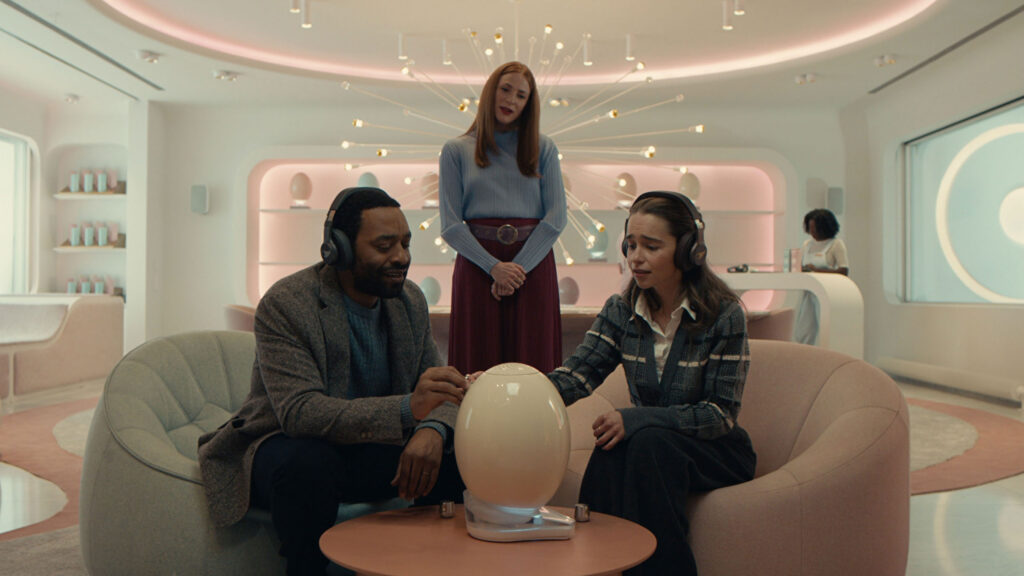
In the first third of the movie, Rachel and Alvy do a lot of bickering and debating about how they want to conceive a child. A company called Pegazus offers an alternative for people who can’t or don’t want to have an unborn baby growing inside a human body. Instead, Pegazus offers a portable, plastic pod in the shape of a large egg to do all the “in utero” work. It’s technology that’s available to those who can afford it—and it doesn’t come cheap, which is one of the reasons why Alvy is dead-set against this option. He doesn’t want any of his or Rachel’s money to be spent on it.
But what a coincidence: Rachel has recently found out that Folio has added this Pegazus pod program to Folio’s health insurance plan for employees. Rachel is told this information when she has a meeting with a Folio human resources executive (played by Aslin Farrell), who doesn’t have a name in the movie. This HR executive makes a lot of cringeworthy and illegal comments to Rachel during a one-and-one meeting in the HR executive’s office. This nosy HR person says a lot of inappropriate things that she probably wouldn’t say to a man. It’s obvious that “The Pod Generation” filmmakers want viewers to notice this sexism.
Rachel is told that she is being considered for a job promotion at Folio. And then the HR executive asks her what Rachel’s husband does for a living. When Rachel tells her, the unprofessional HR executive then snootily says, “So, you’re the primary source of income.” Instead of Rachel balking at this line of illegal questioning, Rachel meekly says, “Yes.”
The questions and comments get worse. The HR executive asks Rachel: “Any plans on extending the family?” Someone with more common sense and self-respect would put a stop to these illegal questions, or at least point out to this odious HR person that Rachel’s family planning is not the company’s business, and it’s illegal to ask these questions when being considered for a job, raise, or promotion.
But apparently, Rachel is too ignorant or she just doesn’t have the courage to stand up for herself and point out these facts. Instead, she stammers this answer: “I’m sure we will at one point. Not in the near, near future, but not immediately.” The HR executive then makes another heinous comment disguised as a semi-compliment: “You’re having a great, great year. It’d be a pity to lose that momentum.” (In other words, what she’s really saying is: “Forget about the promotion if you’re going on maternity leave.”)
And that’s when the HR director mentions that Folio will now cover Pegazus costs in the Folio health insurance plan: “Should you go down that route, we can even help you with the down payment. It’s our hottest perk. We just want to make sure we maintain the best and brightest women.” (In other words, what she’s really saying is: “We don’t want to be reminded that women who get pregnant and give birth have the right to maternity leave, because we think women who take maternity leave are less productive than women who don’t take maternity leave.”)
It’s not spoiler information to say that Rachel eventually convinces Alvy to use the Pegazus way of pregnancy. Alvy and Rachel have the popular option to choose the gender of the child in advance, but they choose not to take that option. Rachel and Alvy also decide not to find out the child’s gender until the child is born. Their unborn baby gestates in a pod that provides all of the fetus’ needs in the same way as if the baby were growing inside a human womb. Just like a human womb, the pod can be part of ultrasound screenings, while the fetus inside can hear any sounds that are nearby. The pod is not supposed to be opened until the time of childbirth.
All of the computer technology connected to each pod is at the Pegazus womb center, which is essentially a pod control center. The pod can be left at the womb center, or the parent(s) of the unborn child can take the pod to pre-approved locations. It’s mentioned that a pod can be autonomous from the womb center for a maximum of 48 hours, in case the person with the pod needs to travel.
Rachel and Alvy attend orientation and counseling sessions with other couples and mothers who are using Pegazus pregnancy pods, but the movie doesn’t present the other people in these sessions as anything but anonymous extras. It’s a huge missed opportunity for more character development. In fact, almost everyone in contact with Rachel and Alvy are anonymous and generic, with a few exceptions.
Rachel has a talkative co-worker friend named Alice (played by Vinette Robinson), who had a Pegazus pod pregnancy with her husband Josh (played by Benedict Landsbert-Noon), who is the passive one in their marriage. Alice had the most influence on Rachel wanting to have a Pegazus pod pregnancy, because Alice is constantly raving about the experience. The Pegazus pre-natal orientation and counseling sessions are led by the Pegazus womb center director Linda Wozcheck (played by Rosalie Craig), who is a perky control freak.
The founder of Pegazus (played by Jean-Marc Barr) is one of many characters in “The Pod Generation” without a name in the movie. He is shown doing a TV or video interview, where he gives off a vibe of being like a combination of a cult leader and a smarmy salesperson. He’s a smooth talker who looks like he’s accustomed to convincing a lot of people to do what he wants them to do.
He says to the interviewer (played by Troy Scully) about Pegazus’ intentions: “At Pegazus, we want fulfilled mothers. We want them to pursue their careers and dreams. Let us do the heavy lifting while you enjoy your babies. We are highly scientific. We use intuition and heart where needed.”
Of course, anyone who’s seen enough of these sci-fi cautionary tale movies will notice that this mysterious Pegazus founder used the phrase “where needed” when talking about intuition and heart. Who gets to make that decision? Rachel and Alvy are supposedly educated professionals, but they never ask a lot of basic questions that people with any common sense would ask before they signed away the pre-natal caregiving rights for their unborn child to Pegazus. And that’s why watching “The Pod Generation” becomes increasingly irritating as it goes along.
This disappointing movie goes into superficial soap opera territory when Rachel doesn’t bond with the fetus in the pod as much as she thought she would, while Alvy bonds with the fetus in the pod more than he thought he would. Rachel starts to get the feeling that the unborn child likes Alvy more than the child likes Rachel. And she’s jealous about it, which leads to more arguments between Rachel and Alvy, as well as more relationship therapy sessions with A.I. program Eliza. (Alvy never completely trusts Eliza, because she is not a human being.)
Meanwhile, Rachel sometimes attaches the pod to her stomach to make it look like a real pregnancy underneath her clothes. It leads to brief moments of her feeling connected to this pregnancy. But then, Rachel gets a harsh lesson in pregnancy body shaming when she brings the pod to her office job. She gets weird looks from co-workers during a conference room meeting when she proudly brings the pod to the meeting.
After the meeting, Alice discreetly advises Rachel (when they’re alone together in an office room) to leave the pod in the employee break room where other expectant parents are keeping their pods. Alice also suggests that from now on, Rachel should leave the pod at the Pegazus womb center until the baby is born. Rachel hates the idea because she wants to spend as much time as possible with the pod. “You don’t want to be labeled ‘the distracted mom,'” Alice warns Rachel about how their co-workers might think of Rachel.
For a movie that has a lot to say about sexism against women (especially when it comes to pregnancy and family planning), none of the characters in “The Pod Generation” gives any pushback or stands up to this sexism. This lack of resistance to sexism from anyone in “The Pod Generation” looks as fake and hollow as one of the movie’s empty pods. Perhaps writer/director Barthes wanted to make some commentary about how this supposedly “progressive” tech-oriented society of “The Pod Generation” is actually socially backwards when it comes to treatment of women and complacent in how technology has taken over their lives.
However, it isn’t the technology that is sexist. The human beings are the ones being sexist, with their cutting remarks and attitudes that aren’t controlled by technology. If “The Pod Generation” is supposed to be a commentary about women losing control of their pregnancies to technology, the movie doesn’t really prove that point either, because Rachel is given access to the pod for most of the movie. “The Pod Generation” never shows the pregnancy journey of any other women except Rachel.
The middle of “The Pod Generation” is a boring rehash of Rachel and Alvy’s marital problems. You don’t need to be a couple’s therapist to see that this pregnancy is not going to solve these problems. And “The Pod Generation” fails to convince viewers why Rachel and Alvy (who aren’t very compatible) fell in love in the first place. Clarke and Ejiofor are perfectly fine in delivering their lines of dialogue, but they don’t have believable chemistry with each other as people who are supposed to be spouses.
Perhaps the biggest letdown of “The Pod Generation” is that it’s a “bait and switch” movie. The movie keeps dropping hints—the sexism, the increasingly controlling ways of Pegazus, the intrusive assumptions of the A.I. technology—that it’s all leading to something very big and very sinister. There is a suspenseful sequence toward the end of the film, but it’s misleading, if you take into consideration how the movie ends. And for a movie that the filmmakers have labeled a “comedy,” there isn’t really anything amusing (not even in a darkly comedic way) about “The Pod Generation.” The movie comes across as technically competent, but soulless—much like the A.I. technology that “The Pod Generation” is aiming to spoof.
UPDATE: Roadside Attractions and Vertical will release “The Pod Generation” in select U.S. cinemas on August 11, 2023.