
Review: ‘The Lychee Road,’ starring Da Peng, Bai Ke, Sabrina Zhuang and Terrance Lau

July 27, 2025

by Carla Hay

Da Peng in “The Lychee Road” (Photo courtesy of CMC Pictures)

“The Lychee Road”

Directed by Da Peng

Mandarin with subtitles

Culture Representation: Taking place during the Tang Dynasty (sometime during the 750s decade) in China, the dramatic film “The Lychee Road” (based on the 2022 novel Lychees of Chang’an) features an-all Asian cast of characters representing the working-class, middle-class and wealthy.

Culture Clash: A mid-level Bureau of Imperial Gardens inspector experiences various dangerous and frustrating obstacles after being tasked with delivering numerous fresh lychees from Lingnan to Chang’an (about 1,553 miles between the two cities) to the emperor for the emperor’s birthday, before the lychees become spoiled in about three days.

Culture Audience: “The Lychee Road” will appeal primarily to people who are interested in suspenseful dramas that are set in ancient times but have themes that are still relevant to today.

Sabrina Zhuang and Bai Ke in “The Lychee Road” (Photo courtesy of CMC Pictures)

“The Lychee Road” is a bittersweet drama that’s partly a race-against-time adventure and partly a piercing observation of corrupt bureaucracy. Da Peng gives a tour-de-force performance as a government inspector tasked with a difficult lychee delivery. Although some of the action scenes are far-fetched, “The Lychee Road” has many other scenarios that are entirely believable and well-acted. The movie also makes good use of comedic moments.

Written and directed by Da Peng, “The Lychee Road” is based on Ma Boyong’s 2022 novel “Lychees of Chang’an.” Shen Yuyue and Dai Siao are also credit as scriptwriters for “The Lychee Road.” (There’s also a 2025 Chinese limited drama TV series called “Litchi Road” that is based on the same book.) The movie takes place during the Tang Dynasty (sometime during the 750s decade) in China, with the story centered on travel to and from the capital city of Chang’an and the city of Lingnan, which are about 1,553 miles (or 2,500 kilometers) apart from each other.

“The Lychee Road” begins by showing a conspiracy plan being set in motion. A eunuch named Yu Chao’en (played by Chang Yuan), who is based on the real politician of the same name and is called Eunuch Yu in the movie, has been given orders to find a government employee who can be a scapegoat for an “impossible mission.” The employee has to deliver several fresh lychees (fruit that resembles red berries on the outside) to the emperor in time for the emperor’s birthday celebration on June 1. Failure to do so could be punishable by being exiled or worse.

The problem is that fresh lychees spoil after about three days, and the emperor specifically wants the lychees to come from Lingnan, which is 1,553 miles away from the emperor’s home base of Chang’an. Eunuch Yu knows that travel by horse and by ship would not be enough time to complete this mission, which is why he’s looking for a lower-level person who will get the blame when the mission is expected to fail. Eunuch Yu is seen meeting with a government director named Biao Biao (played by Yi Yunhe), who gleefully tells him that he knows the perfect person who can be set up for this doomed mission.

The targeted person is Li Shande (played by Da Peng), a middle-aged inspector who works in the Bureau of Imperial Gardens. In a voiceover narration, Shande is shown giving a brief summary of hs adult life: After graduating from college with a degree in mathematics, Shande joined the Bureau of Imperial Gardens at age 24.

Shande has been stuck in the ninth rank (the equivalent of middle management) for several years. He’s underpaid, overworked, and frequently bullied by his supervisors. Shande’s personal life is much happier: He has a very good marriage to his loyal wife Zheng Yuting (played by Yang Mi), and they are devoted parents to their adorable daughter Li Xiu’er, who is about 6 or 7 years old.

Shande is assigned the task and is told that he will get a job promotion to be the official lychee envoy if he completes this mission of delivering lychees to the emperor by June 1. (in real life, Emperor Xuanzong was the emperor of the Tang Dynasty during the period of time that this story takes place.) In addition to a higher salary, the job of lychee envoy would also give perks and prestige to Shande and his family. Shande signs a contract to make this delivery by the deadline.

However, Shande finds out later that he’s been conned: The contract that he signed said that the lychees would be preserved, not fresh. When he gets the contract after he’s signed it, he finds out that a tiny, hard-to-detect sticker with the word “fresh” was placed over the word “preserved” after he signed the contract. This altered contract makes it look Shande has agreed to deliver fresh lychees to the emperor by June 1.

Shande angrily confronts Biao Biao about this contract fraud. Biao Biao says that it’s too late for Shande to back out of the contract. Shande is despondent and in a panic because he knows this mission could ruin his life and the lives of his family members. On the day that Shande leaves for Lingnan, the June 1 deadline is 117 days away. He has this period of time to figure out how to deliver fresh lychees from Lingnan to Chang’an.

Before he leaves for the trip to Lingnan, Shande gets an unexpected visit from Du Shaoling (played by Zhang Ruoyun), the assistant military officer of the Right Guard Command. Shande confides in Shaoling about this big problem. Shaoling advises Shande to find a scapegoat if things go wrong. Shaoling also says that Shande could still possibly leverage the experience into being promoted to lychee envoy. Shande is given a Five Prefectures Pass to make his travels easier.

A skeptical and wary Shande travels by himself to Lingnan, in search of the perfect lychees. He encounters many challenges, including bad weather, wild animals, getting lost, and not knowing where to find lychees that would be suitable for the emperor. When he reaches Lingnan, he gets a hostile reaction from Lingnan’s governor He Qiguang (played by Lam Suet), who has some of his thugs rough up Shande because Qiguang doesn’t believe that Shande in on this mission for the emperor. However, Lingnan’s chief secretary Zhao Xinmin (played by Sunny Sun) intercedes and confirms that Shande’s mission is legitimate.

During Shande’s short visit with the governor, he sees an enslaved young man named Lin Yinu (played by Terrance Lau) being viciously whipped because Yinu has been accused of trying to make a partridge look like a peacock. After witnessing this cruelty, Shande has a private conversation with Yinu and tells Yinu that slavery is illegal in Chang’an. Shande promises that when Shande completes this mission, he will come back to get Yinu and take him to Chang’an, where Yinu can live as a free man.

Yinu, who has some speaking disabilities, ends up running away from his enslavers and following Shande around at an outdoor marketplace and other places where Shande goes. At first Shande is annoyed and thinks Yinu is being a pest. However, Yinu ends up becoming a very helpful assistant and later a trusted ally to Shande.

Just by chance, Shande meets a wealthy heir named Su Liang (played by Bai Ke, also known as White-K), who hears about this mission. Liang is up front in telling Shande that Liang’s father gives preference to Liang’s older brother Su Yan (played Wei Xiang) because their father doesn’t think Liang is a good-enough business. Liang wants to prove to their father that that he can do something successful in business. And so, Liang offers Shande the use of his merchant ship and crew to transport the lychees, with Liang covering all the expenses because Liang says he wants Shande to put in a good word for Liang with the emperor.

In exchange for this generous use of the ship and crew, Shande gives his Five Prefectures Pass to Liang, even though it’s illegal to give this pass to anyone else. Liang also tells Shande that the best lychees in Lingnan are at an orchard owned by a woman named Tong (played by Sabrina Zhuang), who inherited the property from her deceased parents. Tong is very outspoken and mistrustful of “city people.” However, Shande gains her trust, and she agrees to help him.

The rest of “The Lychee Road” shows how mathematician Shande uses some of his probability skills in testing various ways to get the lychees from Lingnan to Chang’an. Along the way, Shande encounters principal chancellor Yang Guozhong (played by Andy Lau), based on the real Yang Guozhong, who want Shande to fail in this mission. Shande also runs into a lot of bureaucractic complications when he has to get several approvals from various government ministry departments.

“The Lychee Road” has certain ideas for Shande’s problem that have more logic than other ideas. Several bureaucrats and other people in power don’t want Shande to succeed because they know that if he succeeds, he will look smarter than they are, and they will be exposed as mediocre or incompetent hacks. Shande’s physical abilities and psychological stamina are put to the ultimate tests.

Shaoling appears from time to time, mostly to give advice to Shande. He tells Shande that the three most important things that he learned as an official are (1) Going with the flow; (2) Sharing the benefits; and (3) Lifting each other up. However, Shande finds out that no amount of diplomacy or sycophancy can get a corrupt enemy to change if that enemy is rotten to the core.

With mostly solid direction and a well-paced screenplay, “The Lychee Road” has some memorable adrenaline-charged action sequences and moments of levity. Shande learns the value of teamwork with people of different backgrounds. The friendship that develops between Shande and Liang is thoroughly enjoyable to watch. Shande becomes like a father figure to Yinu. Shande also earns the respect of Tong.

Although all the cast members in “The Lychee Road” show talent in their roles, Da’s performance as Shande is the heart and soul of the movie. Shande goes through every possible emotion in “The Lychee Road,” which takes viewers on this wild and engrossing journey with Shande. The most underdeveloped character is Shande’s spouse Yuting, who is a stereotypical “worried wife of the hero” for most of her screen time.

The movie’s gorgeous cinematography is stunning, while the visual effects and production design are also above-average. And although there’s plenty of high-octane action and life-threatening things that happen in the story, “The Lychee Road” has some of its greatest impact in the quieter scenes, where guilt and emotional devastation are harder to recover from than physical wounds and injuries.

CMC Pictures released “The Lychee Road” in select U.S. cinemas on July 25, 2025. The movie was released in China on July 18, 2025.

Review: ‘YOLO’ (2024), starring Jia Ling and Lei Jiayin

March 8, 2024

by Carla Hay
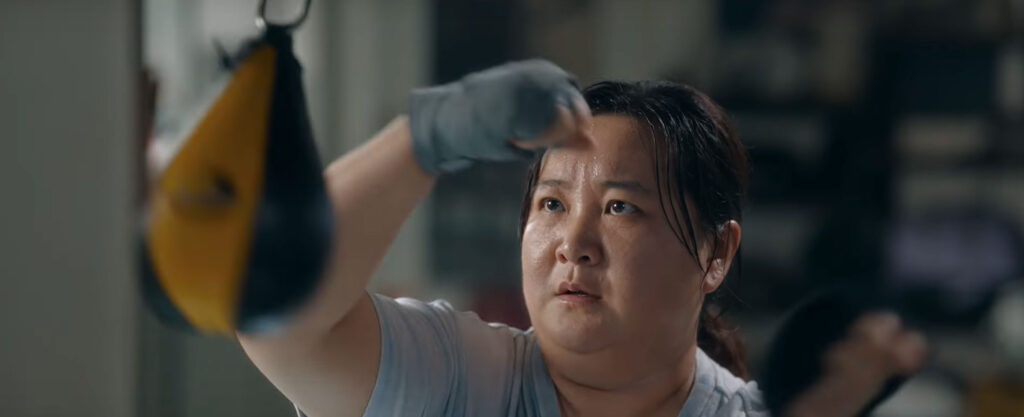
Jia Ling in “YOLO” (Photo courtesy of Sony Pictures International)

“YOLO” (2024)

Directed by Jia Ling

Mandarin with subtitles

Culture Representation: Taking place in Guangzhou, China, the comedy/drama film “YOLO” (based on the 2014 Japanese film “100 Yen Love”) features an all-Asian cast of characters representing the working-class and middle-class.

Culture Clash: A reclusive woman in her 30s gets close to a boxer who works at a gym, and she decides to train with him to become a boxer. 

Culture Audience: “YOLO” will appeal primarily to people who are fans of Jia Ling, boxing movies, and stories about underestimated people who change their own lives for the better.

Lei Jiayin and Jia Ling in “YOLO” (Photo courtesy of Sony Pictures International)

“YOLO” is undoubtedly inspired by the first “Rocky” movie, but this is no “Rocky” ripoff. The movie has some unexpected moments amid some predictability, along with heartfelt drama and a notable transformative performance from writer/director/star Jia Ling. The first third of the movie might be frustrating to watch because the protagonist is portrayed as pathetic, in a way that might appear to be almost insulting to this character. However, as “YOLO” progresses and the protagonist evolves, there are some twists and turns to the story that will take viewers on journey that becomes an emotional inspiration by the end of the movie.

“YOLO” (which is an acronym for “you only live once”) is based on the 2014 Japanese film “100 Yen Love.” “YOLO” (which takes place and was filmed in Guangzhou, China) starts off as mostly a comedy, but then it makes a credible transition to a more dramatic film as changes occur in the protagonist’s life. If the movie has any “feel good” moments, they are earned, because there’s a lot heartache and personal challenges along the way.

The opening scene of “YOLO” takes place right before a boxing match starts between two women at the Xiangjiang Boxing Club. The reigning champ is Liu Hongxia, while her challenger is revealed later when “YOLO” circles back to this scene in the last third of the film. The coach for the challenger can be heard off-camera saying about the boxing match: “Your rival is a pro. If it’s too hard, I’ll stop it.”

The next scene takes place in a convenience store, where store owner Mrs. Du (played by Zhao Haiyan) and her daughter Du Ledan (played by Zhang Xiaofei), who’s in her late 20s, work in the store. Mrs. Du (whose first name is not mentioned in the movie) and Ledan are showing a live surveillance video to Ledan’s distant cousin Doudou (played by Yang Zi), who is an aspiring TV producer/host. The surveillance video is showing Mrs. Du’s older daughter Du Leying (played by Jia), who is 32, as she is sleeping on a couch in the apartment that is located in the same building, behind the convenience store.

Mrs. Du explains with dismay and concern to Doudou that unemployed Leying typically lounges around and does a lot of sleeping during the day. Mrs. Du, her daughters, and Ledan’s daughter all live in the apartment. Ledan is a divorced mother of a daughter named Zhuzi, who’s about 3 or 4 years old. Mrs. Du and her husband Mr. Du (played by Zhang Qi) are separated, and he rarely communicates with his estranged wife and their children.

It’s later revealed that Leying has been chronically unemployed and living an aimless life for about 10 years, ever since Leying graduated from college and had problems keeping a job. Any casual observer can see that Leying is depressed. Leying says she can’t keep a job because she’s not good at communicating with people. Leying doesn’t say it out loud, but she is also self-conscious about her body size.

Meanwhile, Leying’s mother and sister are beginning to get fed up with Leying being unproductive. Doudou works as an intern for a reality TV show about giving chronically unemployed people a chance to turn their lives around. Doudou has been invited by Ledan to interview a reluctant Leying for an audition video for the show. Doudou sees this interview not only as a way to help Leying but also as a way to impress Doudou’s bosses at the TV show and hopefully be offered a permanent job on the show. Leying doesn’t do well during this interview, which frustrates her mother and sister even more.

Leying feels like a misfit and an outsider in her own home. Can her life get any worse? Yes. Leying has a boyfriend named Wei Dong Feng (played by Wei Xiang), who works as a delivery bike rider. Dong Feng has been secretly having an affair with Leying’s best friend Li Li (played by Li Xueqin), who is now pregnant. Li and Dong Feng also plan to get married in the near future.

Li and Leying have been friends since their childhood, when they were both bullied at school. Leying is invited to have lunch with Dong Feng and Li at a restaurant. Dong Feng breaks up with Leying during this lunch. Leying guesses correctly that another woman is the reason for the breakup. She grabs Dong Feng’s phone to find out who it is. And that’s how Leying discovers the truth that Li is “the other woman.” A devastated Leying also finds out about Li being pregnant and about the marriage plans.

On the night of this breakup, a very sad Leying walks around the city. One of the places she passes is a boxing gym. Through the gym window, she sees a man in his late 30s or early 40s who is practicing on a punching bag. Leying doesn’t know it yet, but his name is Hao Kun (played by Lei Jiayin), and he is a former professional boxer who gives boxing lessons at the gym. Leying and Ku will soon meet each other under some embarrassing circumstances.

Leying is unemployed but she isn’t completely broke. She has inherited an apartment from her grandmother that is worth an unnamed amount of money. There’s some jealousy that Leying’s mother and sister have about this inheritance, because Leying is the only one in the family who received this apartment as an inheritance. There’s also a hint of other family turmoil, because it’s mentioned at Mrs. Du is suing her sister for reasons that aren’t detailed in the movie.

Ledan asks Leying to transfer the apartment deed to Ledan, so that Ledan can sell the apartment and use some of the money to send Zhuzi to an elite private school. Leying says no to the request, and the two sisters get into an argument. Ledan’s pent-up resentment comes out at that moment, as she physically attacks Leying by punching Leying and tackling her to the ground. Leying doesn’t put up much of a fight, but this assault is the last straw for her.

Leying moves out of the apartment and finds another place to live. She needs to find a job to pay her rent. She becomes a server at a casual barbecue restaurant owned and managed by an unnamed man (played by Xu Jun Cong), who is very rude and condescending to Leying. It’s because of this restaurant job that Leying meets Kun.

One night, Leying is working at the restaurant, when a drunk customer gives Leying his car keys and asks her to get a pack of cigarettes from the glove compartment of his car, which he describes. The car is parked on a street right outside the restaurant. Leying gets in the car at around the same time that Kun is urinating on an outside wall of the gym, which is next door to the restaurant.

Leying sees Kun urinating and gets flustered. She accidentally turns on the car headlights, which shine directly on Kun. When she tries to turn the headlights off, she accidentally turns on the windshield wipers and the car blinkers. Even though no one else can can see what Kun is doing, he thinks Leying is trying to humiliate him for urinating outside in public.

Kun angrily goes over to the car to confront Leying, and she explains what she’s doing in the car. Kun advises her to ask the car owner what to do. He also tells Leying that he works at the gym and wouldn’t normally urinate in public, but the gym is closed, and he didn’t know where else to urinate.

After this tense conversation, Leying notices that Kun accidentally left his boxing gloves at the front of the building. She takes the gloves for safekeeping, and the next day, Leying goes to the gym to return the gloves to Kun. A female worker at the gym tries to persuade Leying to take boxing lessons at the gym, but Leying declines the offer.

Meanwhile, Kun is under pressure at his job to bring in more gym memberships. His boss tells Kun that Kun is underperforming in gym membership sales, and Kun could be at risk of getting fired. Kun just wants to do boxing at the gym and not be a salesperson. When Leying accidentally tags Kun on social media, he asks her out on a date, with the ulterior motive to try to sell her a gym membership. And so begins the unlikely relationship between Kun and Leying.

Although the trailer for “YOLO” shows Kun training to become a boxer, most of that doesn’t happen until the last third of the movie. The middle of the movie is about Kun training to make a comeback as a boxer. Things get a little complicated when Kun and Leying become sexually intimate, and there’s some uncertainty about how much of a romance they want to have in their relationship.

“YOLO” isn’t a typical boxing movie because it has many issues that are not in most boxing films. Leying is often body shamed because of her weight, which usually has harsher consequences for women than it does for men. For most boxing films, the boxers are not fat when they begin training.

There’s also a turning point for Leying’s self-esteem after she reacts in a certain way to sexual harassment from her boss. And then there’s the matter of Leying being sexually involved with her coach, which is something that is definitely not in most boxing movies. “YOLO” treats the consensual relationship between Leying and Kun with no judgment.

The relationship between Leying and Kun is not “only in a movie” cute. It’s messy, with both tension and warmth. Kun and Leying have arguments, but they are also supportive of each other. He can be very tough on her inside and outside the gym. And all that training results in Leying transforming physically as well as emotionally.

“YOLO” doesn’t shy away from any comparisons to “Rocky,” because there’s a training sequence that is a blatant homage to “Rocky,” including using Bill Conti’s “Gonna Fly Now” theme song from the movie. Are some moments in the move sentimentally earnest? Yes, but not in a way that’s overly cloying.

The heart and soul of “YOLO” is in Jia’s emotionally versatile and physically demanding performance—she gained and lost 50 kilograms (or 110 pounds) of body weight for this role—which is a testament to how it’s never to late for anyone to make improvements in life. Leying goes from someone who hides from life because she’s afraid of getting hurt to someone who finds the courage to live life to the fullest, no matter what the risks. “YOLO” might start out looking like a lightweight boxing comedy, but it ends up packing a powerful punch in the dramatic moments that show how having healthy self-confidence and inner peace are more valuable than external rewards.

Sony Pictures International released “YOLO” in select U.S. cinemas on March 8, 2024. The movie was released in China on February 10, 2024.

Review: ‘Give Me Five’ (2022), starring Chang Yuan, Ma Li and Wei Xiang

December 26, 2022

by Carla Hay

Wei Xiang, Chang Yuan and Ma Li in “Give Me Five” (Photo courtesy of Well Go USA)

“Give Me Five” (2022)

Directed by Zhang Luan

Mandarin with subtitles

Culture Representation: Taking place in China in 2021, the 1980s and 1991, the sci-fi comedy/drama film “Give Me Five” features an all-Asian cast of characters representing the working-class, middle-class and wealthy.

Culture Clash: After his 60-year-old father ends up in a hospital and is experiencing memory loss, a 30-year-old man unexpectedly finds out that he can travel back in time to the 1980s, where he meets his parents before they got married.

Culture Audience: “Give Me Five” will appeal primarily to people who are interested in watching amusing and occasionally poignant stories about time travel and family relationships.

Jia Bing and Chang Yuan in “Give Me Five” (Photo courtesy of Well Go USA)

“Give Me Five” is a convoluted but overall entertaining comedy/drama that will get inevitable comparisons to “Back to the Future,” because of the plot about time travel that could affect the courtship of a man’s parents. The movie is good, but not great. The main difference between the two movies’ plots is that the protagonist in “Back to the Future” is aided by an eccentric scientist, whereas there is no such scientist character in “Give Me Five.”

Directed by Zhang Luan and written by Dong Tianyi, “Give Me Five” begins in 2021, with the introduction of the movie’s protoganst: Wu Xiao, also known as Xioawu (played by Chang Yuan), is a 30-year-old business entrepreneur in an unnamed city in China. After graduating from college, Xiao founded an e-sports training company that is struggling to be a financial success. Xiao has a volatile relationship with his widowed father Wu Hongqi (played by Wei Xiang), who is 60 years old and a retired engineer. Hongqi calls Xiao “useless” for hanging out at Internet cafes all day.

Xiao’s mother died in childbirth. Hongqi, who is a retired engineer, raised Xiao (who is an only child) and never remarried. Xiao says in a voiceover early in the movie: “He might have brought me up, but he’s never liked me. It’s as though we are arch-enemies.” Making things more complicated, Hongqi has been experiencing short-term memory loss, and he sometimes calls Xiao his “brother.”

Early in the movie, there’s another example of how Hongqi is forgetful. On Xiao’s birthday, Honqi asks Xiao to make a wish when Xiao blows out candles on his birthday cake. Xiao asks Honqi for ¥5,000 because Xiao wants to propose to his girlfriend Huahua, and he needs the money for the wedding. Honqi gives Xiao the money but then immediately forgets why. Xiao gets angry and yells at Honqi that if he and Huahua get married, they will be burdened with taking care of Honqi.

Tragedy strikes when Honqi accidentally falls into a river and ends up in a coma, in a hospital. Xiao is worried about his father. But because of their strained relationship, Xiao also complains to his comatose father that they can’t afford the hospital bill.

Honqi’s former co-worker named Qin Shiyu (played by Huang Yuntong), who is a female friend of his, visits Honqi in the hospital. She tells Xiao that when Honqi was younger, he liked Rabindranath Tagore’s poems, which Shiyu reads to Honqi in the hospital. This admiration for Rabindranath Tagore poetry becomes a key point in the movie’s plot.

Back at his family home, Xiao finds a ring, his mother’s diary and a bank account book showing a balance of ¥5,000. He opens the diary to find an entry dated May 30, 1986. And when Xiao, he finds himself transported back to that date. He ends up meeting his parents before they got married.

The rest of the movie shows Xiao traveling back and forth in time from the 1980s to 1991. He can control when he goes back in time, but he doesn’t know when he will be pulled back to the present day. During his time traveling, Xiao finds out that Honqi and Shiyu used to date each other when they were factory co-workers in the 1980s. At the time, Xiao’s mother Lau Chunli (played by Ma Li), also known as Daliu, was a technician at the same factory.

Because his parents don’t know that Xiao is their future son, Xiao presents himself as a new employee. Xiao ends up befriending Honqi, who is nerdy and very insecure about his relationship with Shiyu, who is ambitious and glamorous. Honqi thinks that Shiyu is out of his league and is afraid that she will break up with him.

Daliu is socially awkward and a little bit of a misfit at the factory. She has a crush on Honqi, but he’s so caught up in his relationship with Shiyu that he doesn’t immediately notice how Daliu feels about him. Meanwhile, a former co-worker named Qiang (played by Jia Bing), who was fired from the factory for stealing coal, reappears as a shady businessman with enough money to buy the factory. Qiang wants to make this purchase, but he if he buys the factory, then 2,000 employees will be laid off.

Once the time traveling part of “Give Me Five” happens, most of the movie is about how Xiao handles the love triangle between Honqi, Daliu and Shiyu. Should he interfere? And if he does, could it possibly prevent himself from being born? This time-travel experience also makes Xiao see his father in a different way. Xiao discovers that his father was a lot less confident in his 20s, compared to how Xiao perceived his father to be more self-assured when Honqi was that age.

“Give Me Five” has some deliberately goofy scenarios, and the film derives a lot of comedy from hairstyles, fashion and music from the 1980s. Some of the jokes are a little repetitive but nothing in this movie is so substandard that it’s a turnoff. The performances are engaging enough, with Chang showing talent in carrying most of the movie with his skills in comedy and drama. Even if people who’ve seen these types of movies can easily predict what will happen at the end, “Give Me Five” is sentimental without being too mawkish in its message about appreciating loved ones while they’re still alive and not misjudging them.

Well Go USA released “Give Me Five” in select U.S. cinemas on September 23, 2022.

Copyright 2017-2026 Culture Mix
CULTURE MIX