
Review: ‘Hamnet,’ starring Jessie Buckley, Paul Mescal, Emily Watson and Joe Alwyn

November 24, 2025

by Carla Hay

Pictured clockwise, from left: Paul Mescal, Jessie Buckley, Bodhi Rae Breathnach, Jacobi Jupe and Olivia Lynes  in “Hamnet” (Photo by Agata Grzybowska/Focus Features)

“Hamnet”

Directed by Chloé Zhao

Culture Representation: Taking place in England, from 1580 to 1599, the dramatic film “Hamnet” (based on the novel of the same name) features an all-white cast of characters representing the working-class, middle-class and wealthy.

Culture Clash: Against the wishes of his parents, playwright William Shakespeare marries a mysterious woman named Agnes, they become parents to three children, and they experience a tragedy and deep-seated grief when one of the children dies and becomes the inspiration for Shakespeare’s “Hamlet.”

Culture Audience: “Hamnet” will appeal primarily to people who are fans of the movie’s headliners, filmmaker Chloé Zhao, movies about William Shakespeare and his family, and well-made dramas about family members cope with grief.

Jacobi Jupe and Paul Mescal in “Hamnet” (Photo courtesy of Focus Features)

Superbly acted and artistically filmed, the drama “Hamnet” is a captivating version of the novel about how William Shakespeare and his wife coped with the death of their son. Jessie Buckley and Paul Mescal give stellar and heart-wrenching performances. And although the movie takes place in the 1500s, its themes are timeless.

Directed by Chloé Zhao (who co-wrote the “Hamnet” screenplay with Maggie O’Farrell), “Hamnet” is based on O’Farrell’s 2020 novel “Hamnet.” The movie had its world premiere at the 2025 Telluride Film Festival and made the rounds at several other film festivals in 2025. At the 2025 Toronto International Film Festival, “Hamnet” won the People’s Choice Award, the festival’s top prize. “Hamnet” takes place in England, where the movie was filmed on location in the county of Herefordshire.

“Hamnet” is inspired by real people and real events, although some elements have been changed for the fictional parts of the story. In real life, William Shakespeare was married to a woman named Anne Hathaway. Anne Hathaway is also the name of a famous Oscar-winning American actress who was born in 1982. In “Hamnet,” Shakespeare’s wife is named Agnes.

A significant change from the “Hamnet” book that’s in the movie is William Shakespeare’s name is actually said in the movie, whereas the book avoids mentioning his name. The movie also mentions the name of Stratford-upon-Avon (whose name is not explicitly mentioned in the book), the town where Shakespeare and his family famously lived. He also spent a lot of time in London, as depicted in the “Hamnet” book and movie. For the purposes of this review, the real people are referred to by their last names, while the characters in the movie are referred to by their first names.

“Hamnet” (which takes place from 1580 to 1599) begins by showing how the lives of William Shakespeare (played by Mescal) and Agnes (played by Buckley) diverge and intertwine. When they first meet, William is a Latin tutor for children in an affluent family. He reluctantly has this job because his father John Shakespeare (played by David Wilmot) owes money to the students’ father.

William has taken this job to help John pay off the debt. But what William really wants to do with his life is be a playwright. John thinks this is a foolish career ambition, and he frequently insults William for being overeducated but “wortheless.” John’s mother Mary (played by Emily Watson) isn’t verbally abusive to William, but she also has high expectations for him. She knows that he’s a talented writer, but she thinks he should choose a more sensible profession.

Agnes is the eldest child in a large family where her mother died when Agnes was about 9 or 10 years old. Agnes has a loyal and throughtful brother named Bartholomew (played by Joe Alwyn), who is the closest thing she’s had to a best friend for her entire life. Her father, a sheep farmer who is not seen in the movie, remarried years ago. He has four children with current wife Joan (played by Justine Mitchell): two sons (played by Zac Wishart and James Lintern) and two daughters (played by Eva Wishart and Effie Linnen), who are all seen briefly in the movie.

Agnes has a reputation for being a free-spirit and a loner who likes to spend a lot of time in the woods, where she communes with nature. There has been longtime gossip in the community that Agnes’ mother was some type of forest witch whose supernatural powers were inherited by Agnes. “Hamnet” shows hints that this speculation could be true.

At the very least, Agnes is highly intuitive, superstitious and firmly believes that the forest is a magical place that has healing abilities. She often sleeps outside in the woods. One of the things she also likes to do in the woods is take care of a pet falcon. It’s one of the first things that William sees Agnes doing when their eyes meet and they are instantly smitten with each other.

When it comes to courting Agnes, William moves quickly and uses an effective pickup line when he first talks with Agnes. After he asks Agnes what her name is, she coyly refuses to tell him. Williams says that Agnes will tell him her name after he kisses her. And then, he kisses her, and his prediction comes true. Soon after he meets Agnes, William quits his tutor job by simply leaving in the middle of a teaching session and never coming back.

Agnes and William fall in love and have a whirlwind romance, which is breezed through in the movie with scenes of them frolicking in the woods and then having sexual hookups in places like a wood shed. It isn’t long before William tells Agnes that he’s “handfasted” (engaged) to her, and they find out that she’s pregnant. William wants to marry Agnes, even though he knows both of their families won’t approve.

It’s never a question that William and Agnes are in love with each other. Agnes’ family is worried that low-income William won’t be able to financially support a family. William’s parents are concerned because Agnes isn’t the type of woman they pictured their son marrying, and they think he’s too young to get married. What the movie doesn’t mention is that in real life, Shakespeare was 18 and Hathaway was 26 when they got married. This type of age gap between a younger husband and an older wife was very unusual then, as it is now.

In “Hamnet,” there’s some family drama (mainly from William’s skeptical parents) before it’s decided that Bartholomew should be the one to approve whether or not Agnes and William can get married. Barthlomew and Agnes have a heart-to-heart talk, where he asks her what she sees in this “pasty-faced” impoverished writer. Agnes tells Bartholmew that William is brilliant and has a lot to offer with his artistic writing.

Bartholomew sees how happy Agnes is and approves of the marriage. William and Agnes get married in 1562. And soon afterward, she gives birth to their first child: a daughter named Susannah. Agnes gives birth alone in the woods, just the way that Agnes wanted it to happen.

Three years later, in 1565, Agnes gives birth to twins: son Hamnet and daughter Judith. Mary and two midwives prevent Agnes from giving birth in the woods and insist that Agnes give birth in the family home where Agnes lives. Agnes is certain that not being able to give birth in the woods will bring a curse on the children, but she’s outnumbered and held back by the other women. This childbirth is more difficult because Judith nearly dies from an unnamed respiratory condition, which Judith has for the rest of her life.

“Hamnet” shows that William and Agnes have a happy marriage and are loving and attentive parents to their children. Eldest child Susannah (played by Bodhi Rae Breathnach) is more serious than her playful twin siblings Hamnet (played by Jacobi Jupe) and Judith (played by Olivia Lynes), who like to do things like dress up in each other’s clothes as pranks. Because Hamnet is the only son in the family, he has a special bond with William, who tells Hamnet that Hamnet can be in William’s plays when Hamnet grows up.

Early in the marriage, Agnes sensed that William was getting frustrated and restless with his stalled writing career. And so, she made the difficult decision to send him to London, where he had the best chance of getting recognition and payment for his plays. This decision was frowned-upon by traditional Mary, who thinks that Agnes needs to have a husband living full-time in the family home, in order to properly raise a family.

As the world now knows, Shakespeare did indeed become a successful playwright and is considered to be the most legendary playwright of all time. Although he spent a lot of time in London (where Agnes did not want to move because she thought the London climate would be bad for Judith’s respiratory condition), in “Hamnet,” William is shown going back to his family home in Stratford-on-Avon as often as he could.

The tragedy of Hamnet dying at 11 years old, in 1596 (the movie depicts Hamnet as being a victim of the bubonic plague), is often excruciating to watch in the movie. Jupe’s wonderfully impactful acting as the adorable Hamnet is one of the reasons why Hamnet’s death hits hard. In her performance of a grieving Agnes, Buckley reaches deep inside a despairing mother’s soul and gives heart-piercing screams and tortured stares of inconsolable grief.

Mescal’s coveys a lot with emotions in his expressively haunting eyes in how William copes with the death of Hamnet. After Hamnet dies, the movie becomes even more about Agnes, as William is away and channels his grief into his work. The results of William’s grief would include the play “Hamlet,” starring an eager young actor named Hamnet (played by Noah Jupe, an older brother of Jacobi Jupe in real life), who bears a striking resemblance to the deceased Hamnet.

If there’s any shortcoming to “Hamnet,” it’s in how this 125-minute movie’s screenplay truncates or rushes through the Shakespeare family’s life in some ways. For example, except for Agnes’ brother Bartholomew, the siblings of William and Agnes are briefly seen and then are never seen again. Where are these siblings when William and Agnes are grieving over the death of their son? Don’t expect the movie to answer those questions.

Depsite these minor narrative flaws, the direction, acting, cinematography, production design, costume design and music score for “Hamnet” are all top-notch. Max Ricthter’s music score is one of the particular standouts for how it perfectly sweeps viewers up in the emotions of the scene, in addition to being very memorable music that will stay with viewers long after the movie is over. Ultimately, “Hamnet” impressively depicts the sobering realities of life’s temporary nature but also celebrates the enduring nature of genuine family love.

Focus Features will release “Hamnet” in select U.S. cinemas on November 26, 2025, with an expansion to more U.S. cinemas on December 5, 2025. A sneak preview of the movie was shown in U.S. cinemas on November 16, 2025.

Review: ‘The Tragedy of Macbeth,’ starring Denzel Washington and Frances McDormand

September 24, 2021

by Carla Hay
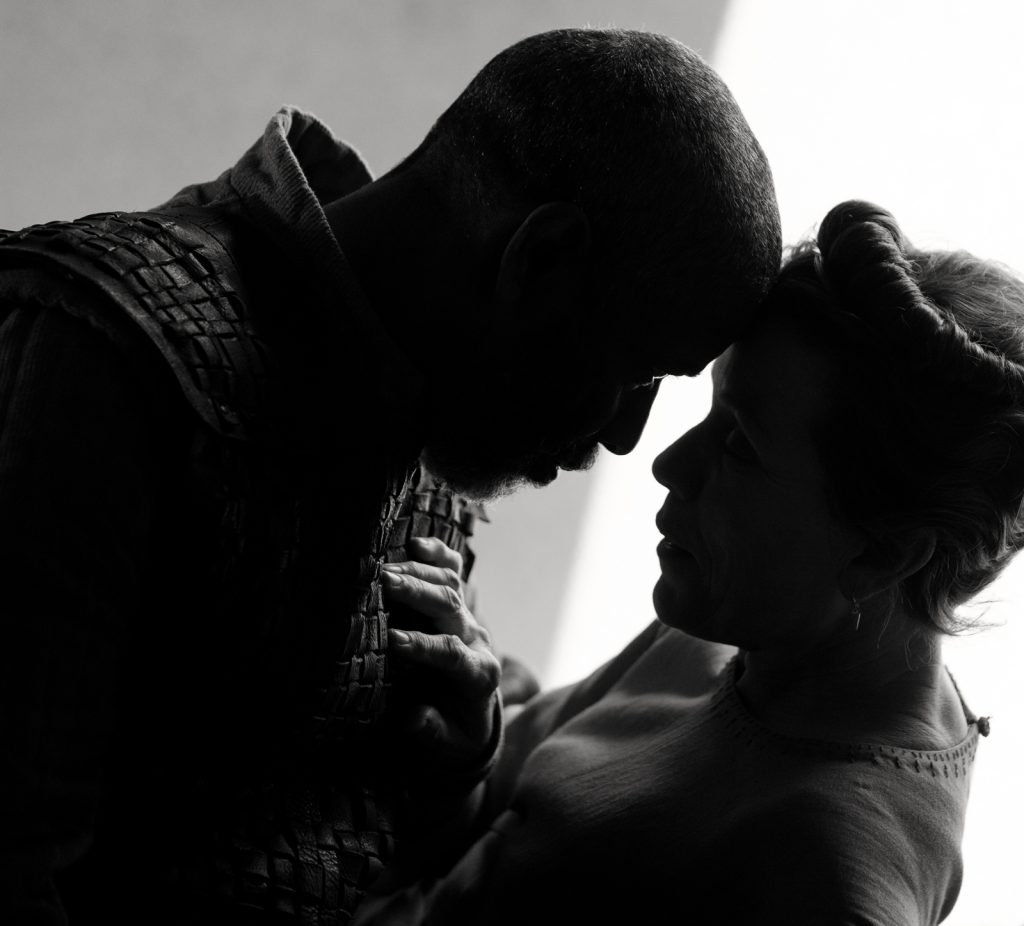
Denzel Washington and Frances McDormand in “The Tragedy of Macbeth” (Photo by Alison Cohen Rosa/A24/Apple TV+)

“The Tragedy of Macbeth” 

Directed by Joel Coen

Culture Representation: Taking place in Scotland and England in the 1600s, the dramatic film “The Tragedy of Macbeth” features a cast of white and black people representing the working-class, middle-class and royalty.

Culture Clash: A ruthlessly ambitious husband and wife lie, cheat and murder their way into becoming king and queen of Scotland, but their sins eventually catch up to them with deadly consequences.

Culture Audience: Besides the obvious target audience of fans of William Shakespeare’s “Macbeth” play, “The Tragedy of Macbeth” will appeal primarily to fans of Oscar winners Denzel Washington, Frances McDormand and Joel Coen.
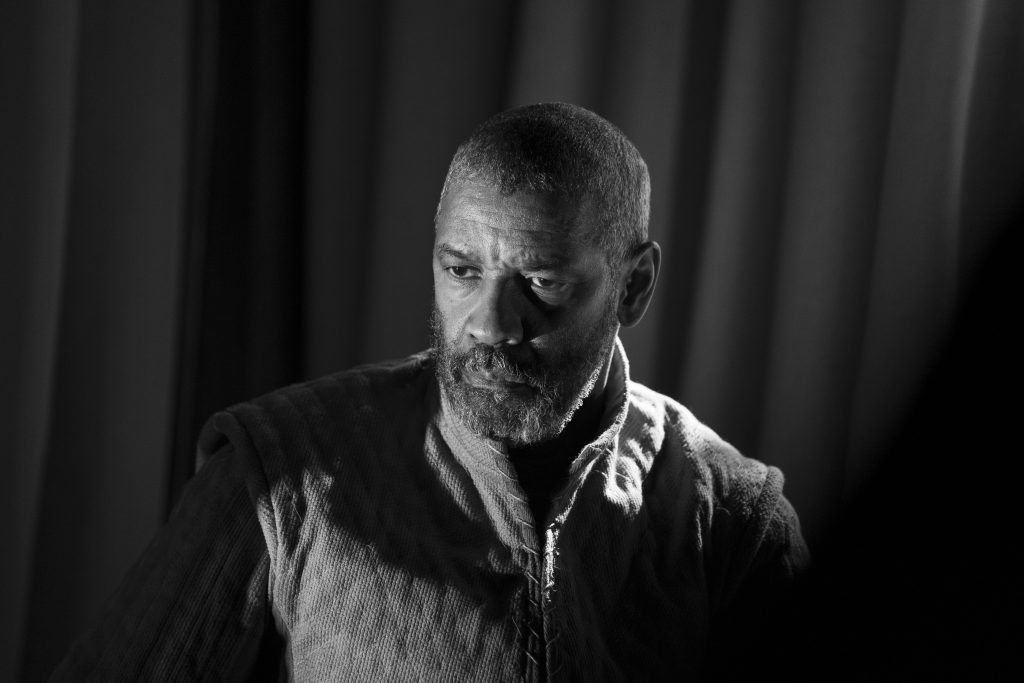
Denzel Washington in “The Tragedy of Macbeth” (Photo by Alison Cohen Rosa/A24/Apple TV+)

“The Tragedy of Macbeth” gives William Shakespeare’s play “Macbeth” the minimalist treatment, laying bare the raw intensity of the story, which is masterfully channeled via powerhouse performances from Denzel Washington and Frances McDormand. Joel Coen (McDormand’s husband and longtime artistic collaborator) wrote and directed “The Tragedy of Macbeth” as a striking hybrid of an observational filmed stage play and an immersive cinematic experience. At a relatively brisk run time of 105 minutes, the movie defies the notion that movies made from Shakespeare’s work have to be pompous, self-indulgent bores. “The Tragedy of Macbeth” had its world premiere at the 2021 New York Film Festival.

Filmed in black and white, “The Tragedy of Macbeth” stays faithful to the source material but rolls out as a more streamlined piece of art that makes this version of the Macbeth story more accessible to people with short attention spans. People interested in watching the movie probably have some familiarity already with Shakespeare’s “Macbeth,” a tragic play that was first performed in 1606 and first published in 1623. Most people would agree that “Macbeth”—with its timeless themes of how a corrupt pursuit of power can destroy lives—remains among the top three of Shakespeare’s best and most well-known work.

There’s really no need to rehash a plot that a lot of viewers will know before seeing this movie. The story is essentially about a married power couple who want to rule over Scotland as king and queen, no matter what the cost. Washington portrays the title character as a man on a mission to get what he feels is owed to him after years of feeling unappreciated as a loyal lord to Scotland’s King Duncan (played by Brendan Gleeson), who is about to be viciously murdered.

The mastermind of this assassination is Macbeth’s wife Lady Macbeth (played by Frances McDormand), whose power and intelligence is underestimated by most people because she is a woman. However, behind the scenes and behind closed doors, Lady Macbeth is a master manipulator who is in many ways more cold-hearted and single-minded in her ambition than her husband is. When he has doubts about any of the dastardly deeds that she has in mind, she pushes those doubts out of his mind and motivates him to follow through with her plans.

Clawing one’s way to the top of Scotland’s royal hierarchy, without being a blood relative of a royal, means that a lot of people will have to die. (The killing scenes aren’t too gory, but there are a few non-explicit scenes involving child murder that might be disturbing for very sensitive viewers.) King Duncan has two adult sons: elder son Malcolm (played by Harry Melling) and Donalbain (played by Matt Helm), who are dutiful but unprepared for the destruction inflicted by the Macbeth couple. As the body count piles up, false accusations will fly, paranoia reaches a fever point, and certain people face a reckoning that seems to ask the question: “Was all that backstabbing worth it in the end?”

Other characters in the play that are also in the movie include Banquo (played by Bertie Carvel), Macbeth’s close ally and a general in King Duncan’s army; Fleance (played by Lucas Barker) Banquo’s son, who’s about 10 or 11 years old in the movie; Macduff (played by Corey Hakwins), Thane of Fife; and Lady Macduff (played by Moses Ingram), Macduff’s wife. Macduff is the first one in the king’s inner circle to suspect that Macbeth and his wife might be up to no good.

Just like like in the “Macbeth” play, the catalyst for Macbeth thinking he has a right to take the throne comes early on in the story when he envisions three witches who tell him a prophecy that he will become the king. However, the introduction of these witches in the movie doesn’t follow standard convention. At first, there’s the appearance of one witch (played by Kathryn Hunter, who plays all three identical witches), who is first seen with her face down in a sandy and barren area, like a vulture who’s hunched over from dehydration.

This witch, just like her look-alikes, is dressed all in black has bird-like mannerisms and even caws like a crow. She contorts her body and flaps her arms, like an ave from hell. And later, when she is joined by the other two witches, they transform into large and menacing black birds.

Washington’s portrayal of Macbeth is as a hothead who is prone to losing control of his emotions and stomping around and shouting as a way to intimidate people. Macbeth is all about short-term gratification. McDormand’s depiction of Lady Macbeth is as someone who is more likely to think long-term and see the big picture.

The difference between Lady Macbeth and her husband is that Lady Macbeth knows when to keep her mouth shut and not give away too much information. Witness the brilliant facial expressions of McDormand as Lady Macbeth in a scene where her husband Macbeth is ranting about something to a group of people in the king’s court. Lady Macbeth thinks he might let some valuable information slip, but she says nothing in order to keep up a façade of ignorance. However, the look on her face shows a brief flash of alarm, as if she’s thinking, “He better not say anything stupid!”

Lady Macbeth has a temper too. She just doesn’t show it to people who could use this “unladylike” demeanor against her. And when McDormand’s Lady Macbeth gets angry, she bellows and barks in a voice that’s deep enough to sound like a man. McDormand’s interpretation of Lady Macbeth is that she knows her own power and strength. She’s not a fussy and frilly wife but one who’s willing to blur the lines of gender roles by showing a more masculine side than how other female actors might interpret this character.

“The Tragedy of Macbeth” has some recurring visual motifs that work well for a movie that was filmed in black and white and has a mild fascination with flight in open skies. First, there are multiple scenes that have a starry night as a backdrop. In a memorable moment, Lady Macbeth let’s go of a burning piece of paper, which flies out the window and into the night. And when the witches turn into birds, which happens more than once in the movie, it also exemplifies the type of flight that conjures of images of dark forces that hover and can’t be tamed.

Another effective visual technique that’s used in “The Tragedy of Macbeth” is conveying the feeling of being spied on and targeted. A scene with Banquo opens with what looks like a spotlight resembling a bullseye lens. The camera zooms up to show an aerial view of Banquo in this spotlight. It’s a foreshadowing of what happens later to Banquo, because he indeed becomes a target. And later in the movie, the three witches are perched on wooden square beams, as the witches look down like vultures ready to pounce.

Because there have been so many different adaptations of “Macbeth,” Coen succeeds in the intent to offer Macbeth through the lens of living in a world where generations of filmmakers and movie audiences have been influenced by the nightmarish lighting contrasts of German Expressionism. The movie’s cinematography (by Bruno Delbonnel), production design (by Stefan Dechant) and visual effects (supervised by Michael Huber and Alex Lemke) are stark and compelling, ranging from set pieces that look like they were made for a theater stage to the majestic simplicity of a cliff that becomes a pivotal location.

And when Lady Macbeth literally lets her hair down in private moments, she can be disheveled—more frump and happenstance than pomp and circumstance. Occasionally messy hair aside, Lady Macbeth’s wardrobe and the rest of the characters’ clothes are completely on point, thanks to stellar costume design by Mary Zophres. The costumes in “The Tragedy of Macbeth” might be the only reason to wish that this movie hadn’t been in black and white. However, the film’s monochromatic pallette is understandable, in order to reflect the dark despair that permeates throughout the story.

The members of this movie’s international cast use their natural accents. Most of the cast members are British. Washington, McDormand and Hawkins are American, while Gleeson is Irish. The varied accents are not a distraction, because the words of Shakespeare make everything sound very much of the era in which it was written. Accents just sound more classical when quoting Shakespeare.

All of the supporting actors in “The Tragedy of Macbeth” play their roles well, with Hawkins being a standout as the intuitive Macduff, a good man who loves his wife and kids and who finds himself in the crosshairs of death and betrayal. It’s hard to go wrong with a Shakespeare classic, a cast of this high level of talent, and a director who consistently makes films whose quality is above-average. The “Macbeth” story is a well-worn road for enthusiasts of performing arts, but “The Tragedy of Macbeth” makes this familiar ride very entertaining.

A24 will release “The Tragedy of Macbeth” in select U.S. cinemas on December 25, 2021. Apple TV+ will premiere the movie on January 14, 2022.

Copyright 2017-2026 Culture Mix
CULTURE MIX