
Review: ‘Malice’ (2025), starring Zhang Xiaofei, Huang Xuan, Teresa Li, Mei Ting, Chen Yusi, Zhang Zixian and Yang Enyou

July 5, 2025

by Carla Hay

Zhang Xiaofei in “Malice” (Photo courtesy of Niu Vision Media)

“Malice” (2025)

Directed by Yao Wenyi

Mandarin with subtitles

Culture Representation: Taking place in 2025 (with flashbacks to 2019), in Hangzhou, China, the dramatic film “Malice” features an-all Asian cast of characters representing the working-class and middle-class.

Culture Clash: When a young hospital nurse and her 10-year-old cancer patient fall from a hospital rooftop, an ambitious TV news anchor rushes to be first with exclusive reports about the investigation, which leads to dire consequences for several people involved.

Culture Audience: “Malice” will appeal primarily to people who are interested in suspenseful dramas about crime cases and how these cases are covered in the media.

Chen Yusi in “Malice” (Photo courtesy of Niu Vision Media)

“Malice” can get a little preachy in its messaging about social media gossip and news media exploitation. However, it’s still an engrossing, twist-filled drama about the mysterious case of a nurse and her 10-year-old cancer patient, who both fell from a hospital rooftop. It’s an impactful story and cautionary tale about how it’s important not to jump to conclusions without getting as many facts as possible.

Directed by Yao Wenyi and written by Zhang Zhen, “Malice” takes place in Hangzhou, China. The movie is set in 2025, but most of the story is a flashback to 2019. “Malice” has thought-provoking commentary about the fickleness of how people are portrayed as “heroes” and “villains” in the media, as well as the extreme and reckless things that some people in the media will do in order to increase their audiences.

“Malice” begins by showing part of what happened at Binjiang Third Hospital in Hangzhou, on the night on September 7, 2019. It’s a rainy night, and a 10-year-old female cancer patient named Jing (played by Yang Enyou) has escaped from her room. A 22-year-old nurse named Li Yue (played by Chen Yusi) chases after Jing, who was diagnosed with neuroblastoma.

Jing and Yue both end up on the building’s high-rise rooftop and fall down onto the ground at the same time after tussling with each other. As a result of this tragic fall, Jing dies instantly, while Yue is a coma. Was Jing’s death an accident or not?

Someone who insists that it’s murder is Jing’s distraught mother You Qian (played by Mei Ting), who says she saw Yue force Jing off of the roof during the tussle between Yue and Jing. Qian was several feet away when she saw the fall and couldn’t save Jing in time. Because Qian saw this incident while it was dark and raining, and she was several feet away, Qian’s eyewitness account could be doubted, but most people in the general public immediately believe her.

Before “Malice” reveals the layers of the story about how this tragedy changed certain people’s lives, the movie cuts to a scene in 2025, where a well-known TV journalist named Ye Pan (played by Zhang Xiaofei) is making a speaking appearance to college-age students in an auditorium. The subject is media manipulation. During the lecture, she shows a video of a college professor named Professor Parker who tied himself to a chair and immersed himself in a tank of water.

As the water tank filled up, Professor Parker did a livestream on social media to say he would let himself drown in the tank if he got 1 million “likes” on the livestream within 31 hours. As the deadline approached, Pan asks the students what they think the outcome would be if they knew the professor had been accused of sexual harassment. Most of the students predicted that the public would want the professor to drown in the tank.

Pan continues to play the video recording until it shows that 1 million views were reached. Professor Parker burst out of the tank and revealed that it was all a social experiment to gauge how far the public was willing to go to “punish” him because of this scandal. Pan goes on to explain that eventually there was video evidence to prove the professor really did commit sexual harassment, but his stunt was an extreme example of “cancel culture” on the Internet. “In this Internet age,” Pan says, “malice is at the fingertips.”

During this speaking appearance in the auditorium, one of the students asks Pan about her involvement in covering the case of Jing and Li Yue falling from Binjiang Third Hospital’s rooftop. And that’s when “Malice” flashes back to 2019 for most of the movie. It should come as no surprise that different versions of what happened on that rooftop caused controversy and condemnations, fueled largely by social media influencers and traditional news reporters.

In 2019, Pan was the chief anchor/executive producer of a public TV news outlet called Evening Channel. And her husband Liang Guan (played by Huang Xuan) was the police captain in charge of investigating this case. At most legitimate news outlets, Pan would not be allowed to investigate the case, due to her spousal conflict of interest. But viewers soon see that Evening Channel isn’t exactly an ethical news outlet.

Pan’s boss Xiao Baoqian (played by Zhang Zixian) is obsessed with making the Evening Channel the media outlet with the largest audience (especially on social media) for this news story and for all news stories. Baoqian gives explicit orders to Evening Channel employees—including a producer named Haozi (played by Lei Songran) and Pan’s intern Chen Chen (played by Teresa Li)—to let them know that Baoqian’s top priority is increasing Evening Channel’s viewership, not ethical journalism. Therefore, Baoqian has no qualms about Pan pursuing this news story, which she is eager to do because she also cares about getting as large an audience as possible.

Pan also has an interest in the case because not long before Jing died, Pan had done an Evening Channel feature story on Jing, Qian, and Jing’s stepfather Wei Qiang (played by Li Xiaochuan), because the family was soliciting donations for surgery that Jing needed. Pan doesn’t ask her husband to compromise his police investigation by telling her what he knows. She wants to do her own independent investigation. She decides to go undercover by pretending to be sick so that she can check into Binjiang Third Hospital as a patient.

While in the hospital, Pan interviews several hospital employees about Yue, who has been already portrayed in the media as a murderous villain. It doesn’t help that Yue’s social media videos and photos revealed that she was struggling with depression and self-esteem issues. Pan finds out from hospital employees that Yue wasn’t very well-liked by her co-workers because people thought she was bossy and rude.

Yue was also the subject of gossip because she was having an affair with Dr. Meng Hao (played by Pei Kuishan), an older married man who was also Jing’s doctor at the hospital. And then, Qian tells Pan an exclusive bombshell: Not long before Jing died, Jing took a photo of Dr. Hao and Yue in a secretive lovers’ embrace at the hospital and had showed the photo to Qian and other people at the hospital.

Yue found out about that Jing took this photo, which caused a scandal where Dr. Hao and Yue were disciplined and their professional reputations were tarnished. Dr. Hao’s wife also caused a scene when she showed up at the hospital and physically attacked Yue. After the scandal, Qian says that Yue told Qian that Yue was suicidal, and Yue made a comment that Yue was going to hell and taking Jing with her. Qian believes this is why she thinks Yue murdered Jing.

Pan puts all this information in a story as exclusive breaking news on Evening Channel. A responsible journalist would’ve done more investigating. However, Pan is feeling pressure to be first with a major story about the case, so she doesn’t do enough fact checking or more investigation. This carelenessness will come back to haunt her.

Pan’s story increases the audience for Evening Channel, which has hired social media influencers to boost the channel’s online coverage of the story. However, some things happen that put Qian’s version of events into doubt. And even more secrets are uncovered that aren’t immediately apparent and won’t be revealed in this review.

Here are some details that can be mentioned without revealing the movie’s biggest plot twists: A young man named Dao Ye (played by Li Jiuxiao), using the alias Lord Dao, comes forward to defend Yue. In an exclusive interview with Pan on live TV, Dao saying that Yue was actually a wonderful person who helped him through a difficult time when he was suicidal and dealing with his biploar disorder.

Dao also says that when Yue got romantically involved with Dr. Hao, it was because Dr. Hao lied to her by saying he was divorced. Dao is outraged that Yue is being called a murderer by many people in the general public. The camera does a close-up of his face durng his interview as he says: “So I ask the 9 million people watching this: ‘Are you really that righteous?'”

Yue’s single mother (played by Ai Liya), who has been keeping a loyal vigil by Yue’s bedside, also says that Yue is not guilty of this murder accusation. Yue’s mother claims that Jing’s mother Qian is lying because Qian has a personal grudge against Yue. And then, a hospital surveillance video is found that puts Qian under suspicion. A medical examiner report also places doubt on Qian’s story.

At first, Pan gets some public criticism for being quick to make Yue look guilty. But in the media feeding frenzy for this case, her journalistic blunders are temporarily forgotten, as Pan admits she could’ve been wrong because of the limited information that she had at the time. Pan and other people following the case move on to other theories and possible “villains,” with the court of public opinion ready to convict someone before it’s determined whether or not a crime took place.

“Malice” has some realistic satire with montages portraying social media influencers trying to jump on the bandwagon with videos of conspiracy theories, condemnations of possible suspects, and performances of original songs about the suspects. This type of media circus is very true of what happens in real life with high-profile crime investigations. “Malice” also has scathing depictions of how people jump to conclusions based on their own personal biases, such as some people on social media saying that Yue is probably guilty, just because Yue came from a broken home where her father abandoned the family.

The movie stumbles when it tries to incorporate Pan and her husband’s relationship in the story. Although it’s easy to see why “Malice” wanted to add this layer of complication to Pan’s investigation, her husband isn’t in the movie enough to make a huge impact on the story. In real life, it would be a much bigger deal for a well-known TV reporter to be married to the chief police investigator of a case that the reporter is covering.

“Malice” has a flashback to another controversial news story that Pan covered in her past. In this news story, Pan did an exposé of people who were paid to give their “clean” urine that could be used by people who wanted to cheat in drug testing that uses urine samples. A tragedy happened as a result of that news story. This tragedy leads to the most soap-opera-like parts of the movie.

“Malice” is by no means perfect. The editing can be choppy, and the pacing of the story is often rushed. The movie also crams in a plot twist near the end related to Pan’s past drug-testing story that comes across as gimmicky. However, the acting performances are well-done, even for some of the two-dimensional characters, such as corrupt boss Baoqian. “Malice” is a fictional film, but it’s also a cautionary tale about real life: People who consume exploitative news stories about scandals are just as complicit in the exploitation as the people who report these types of news stories.

Niu Vision Media released “Malice” in U.S. cinemas on July 4, 2025. The movie was released in China on July 5, 2025.

Review: ‘YOLO’ (2024), starring Jia Ling and Lei Jiayin

March 8, 2024

by Carla Hay
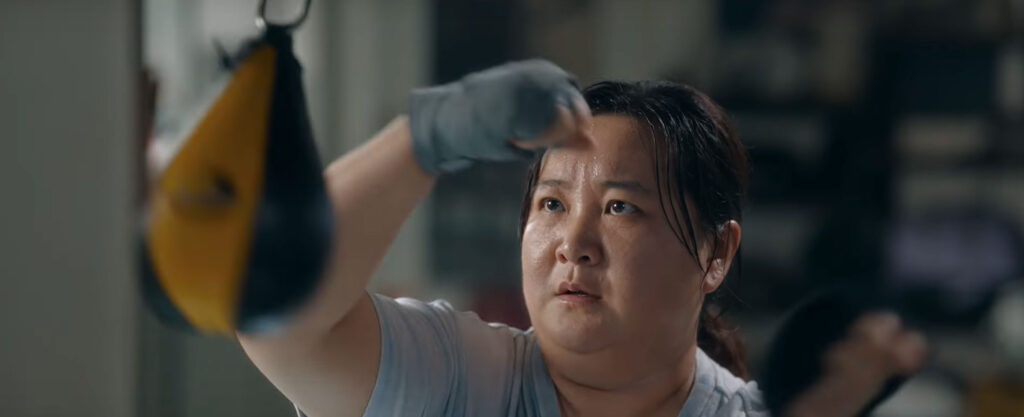
Jia Ling in “YOLO” (Photo courtesy of Sony Pictures International)

“YOLO” (2024)

Directed by Jia Ling

Mandarin with subtitles

Culture Representation: Taking place in Guangzhou, China, the comedy/drama film “YOLO” (based on the 2014 Japanese film “100 Yen Love”) features an all-Asian cast of characters representing the working-class and middle-class.

Culture Clash: A reclusive woman in her 30s gets close to a boxer who works at a gym, and she decides to train with him to become a boxer. 

Culture Audience: “YOLO” will appeal primarily to people who are fans of Jia Ling, boxing movies, and stories about underestimated people who change their own lives for the better.

Lei Jiayin and Jia Ling in “YOLO” (Photo courtesy of Sony Pictures International)

“YOLO” is undoubtedly inspired by the first “Rocky” movie, but this is no “Rocky” ripoff. The movie has some unexpected moments amid some predictability, along with heartfelt drama and a notable transformative performance from writer/director/star Jia Ling. The first third of the movie might be frustrating to watch because the protagonist is portrayed as pathetic, in a way that might appear to be almost insulting to this character. However, as “YOLO” progresses and the protagonist evolves, there are some twists and turns to the story that will take viewers on journey that becomes an emotional inspiration by the end of the movie.

“YOLO” (which is an acronym for “you only live once”) is based on the 2014 Japanese film “100 Yen Love.” “YOLO” (which takes place and was filmed in Guangzhou, China) starts off as mostly a comedy, but then it makes a credible transition to a more dramatic film as changes occur in the protagonist’s life. If the movie has any “feel good” moments, they are earned, because there’s a lot heartache and personal challenges along the way.

The opening scene of “YOLO” takes place right before a boxing match starts between two women at the Xiangjiang Boxing Club. The reigning champ is Liu Hongxia, while her challenger is revealed later when “YOLO” circles back to this scene in the last third of the film. The coach for the challenger can be heard off-camera saying about the boxing match: “Your rival is a pro. If it’s too hard, I’ll stop it.”

The next scene takes place in a convenience store, where store owner Mrs. Du (played by Zhao Haiyan) and her daughter Du Ledan (played by Zhang Xiaofei), who’s in her late 20s, work in the store. Mrs. Du (whose first name is not mentioned in the movie) and Ledan are showing a live surveillance video to Ledan’s distant cousin Doudou (played by Yang Zi), who is an aspiring TV producer/host. The surveillance video is showing Mrs. Du’s older daughter Du Leying (played by Jia), who is 32, as she is sleeping on a couch in the apartment that is located in the same building, behind the convenience store.

Mrs. Du explains with dismay and concern to Doudou that unemployed Leying typically lounges around and does a lot of sleeping during the day. Mrs. Du, her daughters, and Ledan’s daughter all live in the apartment. Ledan is a divorced mother of a daughter named Zhuzi, who’s about 3 or 4 years old. Mrs. Du and her husband Mr. Du (played by Zhang Qi) are separated, and he rarely communicates with his estranged wife and their children.

It’s later revealed that Leying has been chronically unemployed and living an aimless life for about 10 years, ever since Leying graduated from college and had problems keeping a job. Any casual observer can see that Leying is depressed. Leying says she can’t keep a job because she’s not good at communicating with people. Leying doesn’t say it out loud, but she is also self-conscious about her body size.

Meanwhile, Leying’s mother and sister are beginning to get fed up with Leying being unproductive. Doudou works as an intern for a reality TV show about giving chronically unemployed people a chance to turn their lives around. Doudou has been invited by Ledan to interview a reluctant Leying for an audition video for the show. Doudou sees this interview not only as a way to help Leying but also as a way to impress Doudou’s bosses at the TV show and hopefully be offered a permanent job on the show. Leying doesn’t do well during this interview, which frustrates her mother and sister even more.

Leying feels like a misfit and an outsider in her own home. Can her life get any worse? Yes. Leying has a boyfriend named Wei Dong Feng (played by Wei Xiang), who works as a delivery bike rider. Dong Feng has been secretly having an affair with Leying’s best friend Li Li (played by Li Xueqin), who is now pregnant. Li and Dong Feng also plan to get married in the near future.

Li and Leying have been friends since their childhood, when they were both bullied at school. Leying is invited to have lunch with Dong Feng and Li at a restaurant. Dong Feng breaks up with Leying during this lunch. Leying guesses correctly that another woman is the reason for the breakup. She grabs Dong Feng’s phone to find out who it is. And that’s how Leying discovers the truth that Li is “the other woman.” A devastated Leying also finds out about Li being pregnant and about the marriage plans.

On the night of this breakup, a very sad Leying walks around the city. One of the places she passes is a boxing gym. Through the gym window, she sees a man in his late 30s or early 40s who is practicing on a punching bag. Leying doesn’t know it yet, but his name is Hao Kun (played by Lei Jiayin), and he is a former professional boxer who gives boxing lessons at the gym. Leying and Ku will soon meet each other under some embarrassing circumstances.

Leying is unemployed but she isn’t completely broke. She has inherited an apartment from her grandmother that is worth an unnamed amount of money. There’s some jealousy that Leying’s mother and sister have about this inheritance, because Leying is the only one in the family who received this apartment as an inheritance. There’s also a hint of other family turmoil, because it’s mentioned at Mrs. Du is suing her sister for reasons that aren’t detailed in the movie.

Ledan asks Leying to transfer the apartment deed to Ledan, so that Ledan can sell the apartment and use some of the money to send Zhuzi to an elite private school. Leying says no to the request, and the two sisters get into an argument. Ledan’s pent-up resentment comes out at that moment, as she physically attacks Leying by punching Leying and tackling her to the ground. Leying doesn’t put up much of a fight, but this assault is the last straw for her.

Leying moves out of the apartment and finds another place to live. She needs to find a job to pay her rent. She becomes a server at a casual barbecue restaurant owned and managed by an unnamed man (played by Xu Jun Cong), who is very rude and condescending to Leying. It’s because of this restaurant job that Leying meets Kun.

One night, Leying is working at the restaurant, when a drunk customer gives Leying his car keys and asks her to get a pack of cigarettes from the glove compartment of his car, which he describes. The car is parked on a street right outside the restaurant. Leying gets in the car at around the same time that Kun is urinating on an outside wall of the gym, which is next door to the restaurant.

Leying sees Kun urinating and gets flustered. She accidentally turns on the car headlights, which shine directly on Kun. When she tries to turn the headlights off, she accidentally turns on the windshield wipers and the car blinkers. Even though no one else can can see what Kun is doing, he thinks Leying is trying to humiliate him for urinating outside in public.

Kun angrily goes over to the car to confront Leying, and she explains what she’s doing in the car. Kun advises her to ask the car owner what to do. He also tells Leying that he works at the gym and wouldn’t normally urinate in public, but the gym is closed, and he didn’t know where else to urinate.

After this tense conversation, Leying notices that Kun accidentally left his boxing gloves at the front of the building. She takes the gloves for safekeeping, and the next day, Leying goes to the gym to return the gloves to Kun. A female worker at the gym tries to persuade Leying to take boxing lessons at the gym, but Leying declines the offer.

Meanwhile, Kun is under pressure at his job to bring in more gym memberships. His boss tells Kun that Kun is underperforming in gym membership sales, and Kun could be at risk of getting fired. Kun just wants to do boxing at the gym and not be a salesperson. When Leying accidentally tags Kun on social media, he asks her out on a date, with the ulterior motive to try to sell her a gym membership. And so begins the unlikely relationship between Kun and Leying.

Although the trailer for “YOLO” shows Kun training to become a boxer, most of that doesn’t happen until the last third of the movie. The middle of the movie is about Kun training to make a comeback as a boxer. Things get a little complicated when Kun and Leying become sexually intimate, and there’s some uncertainty about how much of a romance they want to have in their relationship.

“YOLO” isn’t a typical boxing movie because it has many issues that are not in most boxing films. Leying is often body shamed because of her weight, which usually has harsher consequences for women than it does for men. For most boxing films, the boxers are not fat when they begin training.

There’s also a turning point for Leying’s self-esteem after she reacts in a certain way to sexual harassment from her boss. And then there’s the matter of Leying being sexually involved with her coach, which is something that is definitely not in most boxing movies. “YOLO” treats the consensual relationship between Leying and Kun with no judgment.

The relationship between Leying and Kun is not “only in a movie” cute. It’s messy, with both tension and warmth. Kun and Leying have arguments, but they are also supportive of each other. He can be very tough on her inside and outside the gym. And all that training results in Leying transforming physically as well as emotionally.

“YOLO” doesn’t shy away from any comparisons to “Rocky,” because there’s a training sequence that is a blatant homage to “Rocky,” including using Bill Conti’s “Gonna Fly Now” theme song from the movie. Are some moments in the move sentimentally earnest? Yes, but not in a way that’s overly cloying.

The heart and soul of “YOLO” is in Jia’s emotionally versatile and physically demanding performance—she gained and lost 50 kilograms (or 110 pounds) of body weight for this role—which is a testament to how it’s never to late for anyone to make improvements in life. Leying goes from someone who hides from life because she’s afraid of getting hurt to someone who finds the courage to live life to the fullest, no matter what the risks. “YOLO” might start out looking like a lightweight boxing comedy, but it ends up packing a powerful punch in the dramatic moments that show how having healthy self-confidence and inner peace are more valuable than external rewards.

Sony Pictures International released “YOLO” in select U.S. cinemas on March 8, 2024. The movie was released in China on February 10, 2024.

Copyright 2017-2026 Culture Mix
CULTURE MIX