
Review: ‘Anniversary’ (2025), starring Diane Lane, Kyle Chandler, Madeline Brewer, Zoey Deutch, Phoebe Dynevor, Mckenna Grace, Daryl McCormack and Dylan O’Brien

October 29, 2025

by Carla Hay

Kyle Chandler and Diane Lane (both standing) in “Anniversary” (Photo by Owen Behan/Roadside Attractions and Lionsgate)

“Anniversary” (2025)

Directed by Jan Komasa

Culture Representation: Taking place in the Washington, D.C./Maryland area, from 2024 to 2029, the dramatic film “Anniversary” features a predominantly white cast of characters (with a few black people) representing the working-class, middle-class and wealthy.

Culture Clash: A tight-knit family is disrupted when a woman, who eventually marries into the family, writes a best-selling book that becomes the bible of a cult-like movement that turns the United States into a totalitarian nation that punishes people for dissenting.

Culture Audience: “Anniversary” will appeal primarily to people who are fans of the movie’s headliners and heavy-handed, soap-opera-type dramas about people in an oppressive society.

Kyle Chandler and Diane Lane in “Anniversary” (Photo by Owen Behan/Roadside Attractions and Lionsgate)

“Anniversary” has a provocative concept about a family affected by the U.S. becoming a massive cult that’s ruled by a totalitarian government. This misguided drama turns into a clumsy mess with hokey and insipid plot twists rushed into the last 20 minutes. The plot twists are not ridiculous on their own, but ridiculous in how they are presented.

The plot twists happen so quickly and melodramatically in the story, it kind of ruins the movie. Meanwhile other parts of the story have huge gaps of missing information that should be in the film. “Anniversary” has the benefit of a talented cast (most of whom give serviceable yet often over-wrought performances), but the cast members are stuck in a movie that is determined to hammer home its points while frequently dropping the hammer.

Directed by Jan Komasa and written by Lori Rosene-Gambino, “Anniversary” takes place from 2024 to 2029, in the Washington, D.C./Maryland area. The movie was actually filmed in Ireland. “Anniversary” has some big ideas, but the movie is quite lazy in developing most of the characters in the family at the center of the story.

“Anniversary” begins by showing a woman in her late 20s rehearsing a greeting in front of a mirror. Her name is Elizabeth “Liz” Nettles (played by Phoebe Dynevor), and she is practicing what she is going to say when she meets the married parents of her boyfriend at the parents’ 25th wedding anniversary party, which will be held at the parents’ Maryland home. “It’s lovely to meet you, Mr. and Mrs. Taylor” Liz says in her rehearsed speech, as she adds a congratulations on the spouses’ 25th wedding anniversary.

The way this opening scene plays out, it’s very much like a Lifetime movie, where you know immediately that this seemingly demure and soft-spoken woman is cold and calculating with a devious plan. In other words, “Anniversary” makes it obvious from the beginning that Liz is up to no good and is going to be the main instigator of the chaos in this family. Liz isn’t seen for more than half of “Anniversary,” but that’s not the movie’s only problem.

The next scene shows Georgetown University sociology professor Ellen Taylor (played by Diane Lane) giving a lecture to a classroom of students. The title of the lecture is “What Is Culture?” Ellen says, “I am neither a liberal or a conservative. I prefer to be a free artist and nothing more—free from violence and lies.”

Ellen then talks about the absurdity of human conditions when people are forced to confront realities that contradict their world views. “Does that sound familiar to anyone in here?” Ellen smirks. “America today, perhaps?” There’s muttering in the audience that implies many of her students agree with her.

Ellen is one-half of the couple celebrating this 25th wedding anniversary. Ellen’s husband is Paul Taylor (played by Kyle Chandler), who owns a restaurant that is frequented by powerful politicians and bureaucrats. Unlike his often-blunt and confrontational wife Ellen, Paul prefers to be non-confrontational and diplomatic.

Paul’s tendency to want to diffuse conflicts is evident in Paul’s first scene in “Anniversary.” Two customers named Senator Coyle (played by Carl Austin) and Senator Hunt (played by Phelim Drew) are having lunch together at Paul’s restaurant. After Paul warmly greets these two senators, they ask Paul to settle a debate: Does New York or Chicago have better pizza? The senators name a New York restaurant and a Chicago restaurant as an example. Paul tactfully answers that one restaurant has better sauce, while the other restaurant has better pizza crust.

The Taylor couple’s anniversary dinner party has about 50 to 75 people in attendance and is held mainly in the backyard of the couple’s home. All four of the couple’s children are in attendance. Several friends and colleagues of Paul and Ellen are also at the party. During the party, the various dynamics in the family are seen and will have an effect on many things that happen later in the movie.

These are four children of Paul and Ellen:

  • Cynthia Taylor (played by Zoey Deutch) is a high-strung attorney who is very focused on her career. Cynthia and her image-conscious attorney husband Rob Thompson (played by Daryl McCormack) are both environmental lawyers. Rob is eager to start a family, but Cynthia doesn’t think it’s the right time and doesn’t seem to like children at all.
  • Anna Taylor (played by Madeline Brewer) is a famous stand-up comedian who is brash, bawdy and very outspoken. Anna, who is queer or a lesbian, has a tendency to get sexually involved with her female personal assistants. Anna can also be a verbal bully when she wants to feel superior to someone.
  • Josh Taylor (played by Dylan O’Brien) is an aspiring writer who feels like a failure because his first book (a sci-fi novel) has recently been rejected by every publisher where it was pitched. Many people in the family are aware that Josh feels insecure because he’s perceived as not as successful as his over-achieving sisters. Josh has brought his new girlfriend Liz (also known as the future troublemaker) as his date to this party, where Liz will meet Josh’s family for the first time.
  • Birdie Taylor (played by Mckenna Grace), the youngest sibling, is a quiet loner who is an aspiring biologist. (She has a mini-scientific lab that she set up in her bedroom.) In the beginning of the movie, Birdie is about 16 or 17 years old and living with her parents. Birdie has a mutual crush on a schoolmate named Moses Ho (played by Sky Yang), whose immigrant mother does some housework for the Taylor family.

It’s mentioned later on in the movie that Paul and Ellen had their children after getting married. One of the disconcerting things about “Anniversary” is that, except for Birdie, none of these adult children look like they’re under the age of 25 when the 25th anniversary party happens. Cynthia, Anna and Josh all look like they’re in their early-to-mid-30s, as were all the cast members playing these characters when they filmed this movie.

The movie never explains how Cynthia is an attorney if she’s under age 25. Although it’s possible in the U.S. to be a practicing attorney who’s under the age of 25, it’s very rare. In other words, the “Anniversary” filmmakers needed to do a better job of casting people who convincingly look like the ages they’re supposed to be in the movie.

“Anniversary” takes place over five years, but in the beginning of the movie, the adult children look too old for people who are supposed to be in their early-to-mid 20s. There was no effort to change how these characters looked over the years, except for changing some of their hairstyles and wardrobe choices. It’s a failure of imagination from the movie’s director and the movie’s makeup department.

The anniversary party goes smoothly except for some tense moments that involve (you guessed it) newcomer Liz. She gives her rehearsed speech when Josh introduces Liz to his parents. Ellen is polite but a little standoffish to Liz. And there’s a reason why, which the movie reveals in a roundabout way: From 2013 to 2016, Liz was a student at Georgetown University, where Ellen was one of Liz’s professors. Liz dropped out of Georgetown because of a feud she had with Ellen.

The feud started because Ellen took offense to an assignment thesis that Liz wrote about how the United States should have only one political party, in order to increase unity among U.S. citizens. Ellen felt that this thesis was very inflammatory and anti-democratic. Ellen flagged the thesis as problematic, which caused some turmoil with Liz’s academic status at the university. Liz argued that she didn’t do anything wrong, but she seemingly backed off from the fight when she dropped out of Georgetown. Ellen didn’t see Liz again until the anniversary party.

When Josh introduces Liz to his parents, he excitedly tells them that he’s helping Liz work on her upcoming book, which Liz describes as a “self-organizing guide.” Ellen eventually tells Liz at the party that she remembers Liz from when Liz was a Georgetown student. Ellen makes it clear to Liz that she still doesn’t trust Liz because of Liz’s controversial thesis. When Ellen privately tries to warn Josh about Liz, Josh responds by telling Ellen that Liz already told him about the past conflicts between Ellen and Liz, and he wants Ellen to move past any grudges and treat Liz with respect.

Ellen suspects that Liz deliberately got involved with Josh as some kind of revenge against Ellen. She also thinks that Liz has dangerously radical ideas and doesn’t want Josh to be brainwashed by these ideas. Ellen voices these concerns to Paul, who tells Ellen that Ellen is being paranoid. Paul is more willing to accept Liz, whom he thinks is harmless. Paul sees that Liz seems to make Josh happy. And for now, that’s all that matters to Paul, when it comes to Liz.

As the relationship between Liz and Josh gets more serious, Liz sends Ellen a gift in the mail: Liz’s published book. It’s called “Change: The New Social Construct.” Ellen notices that the book’s forward is dedicated to “the haters, the doubters, academic stranglers.” Ellen wryly laughs because she thinks the “academic stranglers” description is a thinly veiled dig at Ellen.

Liz’s “Change” book has the same radical ideas that Liz had in her university thesis. The book touts a belief that society is more likely to be unified and peaceful if there weren’t divisions (such as political parties) and if decisions were made for the common good instead of individual freedoms. Liz’s “Change” book is celebrated and taught as a mission by a mysterious think-tank corporation called the Cumberland Company, where Josh and Liz are hired and eventually become wealthy high-ranking leaders.

“Change” ends up selling 10 million copies and has a widespread fan base that becomes a cult for the ideas preached in the book. The “Change” cult ideology becomes so huge, it takes over all aspects of the U.S. government. All political parties are abolished. Government surveillance is everywhere and is used as evidence to persecute people who don’t follow the “Change” groupthink ideology.

Freedom rights for individuals are discouraged or outlawed. People who question, give criticism, or protest against government policies are put on a government watch list or arrested and often falsely accused of serious crimes. Even the American flag is altered, so that the block of stars is in the middle of the flag instead of the side. The last two-thirds of “Anniversary” are about how these drastic changes in America affect the Taylor family.

One of the Taylor family members goes into hiding, out of fear of being arrested. This disappearance serves as a catalyst for most of the trauma cram that happens near the end of the movie. It should come as no surprise which of the family members are the most resistant to the “Change” cult mentality/lifestyle. However, the movie has a very superficial way of presenting these characters, who are mostly underdeveloped.

Ellen has a meltdown that seems to last for the entire five years, where she is seen becoming addicted to smoking marijuana and posting anti-government rants on the Internet. (Not surprisingly, Ellen gets fired from Georgetown University after she did something “un-American” that was caught on video and went viral.) Paul continues to be passive for most of the story until a certain part where he finally shows some backbone, but it might be too late.

Just as Ellen feared would happen, Josh gets married to Liz, starts a family with Liz, and becomes completely sucked into the “Change” lifestyle and cult beliefs. And yet for all of Ellen’s warnings about Liz, this manipulative “mastermind” isn’t seen for most of the movie. Hardly anything is revealed about Liz’s life before her conflicts with Ellen, which means there’s no explanation for why Liz is the way that she is. The only thing that is told about Liz’s personal background is when Liz and Ellen are talking at the 25th anniversary party, and Liz mentions that she’s an “only child by way of a nasty divorce” and that her rage fuels her writing.

Liz being such a mystery just makes the movie look cowardly or unimaginative about depicting someone who is supposed to be the story’s chief villain. A better movie would’ve shown how Liz was able to quickly grow this empire, in order to make the story more believable. Leaders of large cults almost always have some type of magnetic charisma, but the way Liz is written and portrayed in this movie, she’s as dull as a worn-out dishrag.

It’s never depicted on screen whatever Liz did (besides write a book) in her rapid ascent to not just become a leader of the “Change” cult but also a powerful influencer in government policies. She’s never seen actually “working” or hobnobbing with the highest-ranking people in the U.S. government. (Appearing in commercials for the Cumberland Company doesn’t count.) This vagueness about Liz is an example of how “Anniversary” lacks creativity in having memorable characters.

Instead, “Anniversary” wastes time showing several Taylor family arguments in the consecutive yearly increments portraying what happens in the five-year period since Ellen and Paul’s 25th anniversary party. Ellen and Paul’s wedding anniversary is the marking point for each of the years depicted in the movie. As prickly and perceptive Ellen, Lane gives enough humanity that’s needed for her role. Unfortunately, the other characters in the Taylor family are mostly hollow. O’Brien gives a committed performance as Josh, but the character is written as a sad-sack-turned-villain caricature.

The movie’s greatest disservice is in how it doesn’t show enough of the interior lives of the Taylor sisters. Birdie goes through a transformation that is hinted at early in the movie but never explored in a believable way. The story arcs for Cynthia and Anna are also disjointed and look like brief glimpses of their lives instead of making them look like fully formed human beings with lives worth watching. The pacing of “Anniversary” drags in some areas before the movie careens into a very phony-looking, hysteria-filled climax that is more likely to induce eye-rolling disappointment from viewers instead of the intended mind-blowing awe.

Roadside Attractions and Lionsgate released “Anniversary” in U.S. cinemas on October 29, 2025. The movie will be released on digital and VOD on November 21, 2025.

Review: ‘Juror #2,’ starring Nicholas Hoult, Toni Collette, J.K. Simmons and Kiefer Sutherland

November 4, 2024

by Carla Hay

A scene from “Juror #2.” Pictured in front row, from left to right: Chikako Fukuyama, Nicholas Hoult, Adrienne C. Moore, J.K. Simmons, Drew Scheid and Hedy Nasser. Pictured in back row: Leslie Bibb and Cedric Yarbrough. (Photo by Claire Folger/Warner Bros. Pictures)

“Juror #2”

Directed by Clint Eastwood

Culture Representation: Taking place in 2021, in Chatham County, Georgia, the dramatic film “Juror #2” features a predominantly white cast of characters (with a few African Americans, Asians and Latin people) representing the working-class and middle-class.

Culture Clash: A magazine writer is selected to be on a jury for a murder trial when he finds out that the person who died might not be a murder victim but a victim of a hit-and-run accident that he caused a year earlier.

Culture Audience: “Juror #2” will appeal mainly to people who are fans of the movie’s headliners, director Clint Eastwood, and gripping courtroom/legal dramas that have very good acting.

People who love dramas about crime investigations and jury trials will find a lot to like about “Juror #2.” It’s an absorbing and suspenseful story about a juror with a very big secret that influences his actions as a jury member. The secret is revealed early enough in the movie for viewers to know if the person on trial is guilty or not guilty. The real mystery is what the guilty party will do to reveal or cover up the truth.

Directed by Clint Eastwood and written by Jonathan Abrams, “Juror #2” is the feature-film debut for screenwriter Abrams. It’s a very taut thriller that has a few minor plot holes or unanswered questions that don’t take away from the overall impact of the movie. Some viewers expecting a certain outcome might not like how the movie ends. “Juror #2” had its world premiere at the 2024 edition of AFI Fest.

“Juror #2” takes place in Chatham County, Georgia, where the movie was filmed on location. The story’s protagonist is Justin Kemp (played by Nicholas Hoult), a mild-mannered man who works as a writer for an unnamed regional lifestyle magazine. The movie takes place over the course of a few weeks in October 2021, although there are some flashbacks to things that happened in October 2020.

In October 2021, Justin and his schoolteacher wife Allison Crewson (played by Zoey Deutch) are anticipating the birth of a child, whose gender has not yet been revealed. Allison is in her third trimester of the pregnancy and is due to give birth on October 25, 2021. It’s later revealed that Allison had a miscarriage of twins in October 2020, which is why she and Justin are particularly anxious about her current pregnancy. So far, Allison hasn’t been experiencing any major health issues for this pregnancy.

Justin seems like an upstanding family man. However, he has a very troubled past that Allison knew about before they got married. Justin is a recovering alcoholic who’s been arrested and convicted in the past for more than one DUI. He got lucky and apparently didn’t get a felony conviction for his DUI cases, which would explain why Justin is eligible for jury duty. Justin has been clean and sober for a few years, which is about the same amount of time that he and Allison have been married.

Justin gets a jury duty notice, but he thinks he’ll be able to get out of jury duty if he explains that his wife is due to give birth any day that he would be required to be on jury duty in the next several days. Before he goes to the courthouse, Justin and Allison joke that Justin could just say something obscene or weird to get out of jury duty.

During this time, the local news has been saturated with reports about the upcoming trial of James Michael Sythe (played by Gabriel Basso), who is accused of the first-degree murder of his 26-year-old girlfriend Kendall Alice Carter (played by Francesca Eastwood), who died on October 21, 2020. Kendall’s mutliated body was found on a steep incline in a wooded area near a barrier rail on Old Quarry Road, which does not have lighting at night. Her death was ruled a homicide from blunt force trauma.

The defendant in this trial has a history of criminal activities, including domestic violence against Kendall, as well being a known drug dealer. He became the prime suspect because on the rainy night of Kendall’s death, he and Kendall were seen having a physical fight inside and outside a local bar called Rowdy’s Hideaway. People at the bar last saw Kendall and James that night when the couple’s arguing continued in the bar’s parking lot.

Kendall walked away from the bar, and James followed her by foot. Witnesses later testify that Kendall and James had a volatile relationship where they would get in physical fights, break up, and then get back together again. Kendall’s last night alive at Rowdy’s Hideaway is shown in several flashback scenes.

This murder case is being prosecuted by ambitious and steely Faith Killebrew (played by Toni Collette), who is in the midst of a campaign to be elected district attorney. James is represented by public defender Eric Resnick (played by Chris Messina), who is as tough as Faith. Eric fully believes that James is not guilty of killing Kendall and thinks there wasn’t a proper investigation into other possible persons of interest or reasons for Kendall’s death.

And there’s room for reasonable doubt. For starters, there were no witnesses, and no murder weapon was found. However, James doesn’t have a verifiable alibi of where he was at the time of Kendall’s death. He says he drove home alone and wasn’t on Old Quarry Road. There’s no security camera footage to prove or disprove he’s telling the truth. And it appears he had a clear motive to kill Kendall. James has rejected a plea bargain deal and wants to go to trial.

During jury selections, Justin finds out that his jury duty is for this trial. And that makes him want to get out of jury duty even more, because murder trials can be unpredictable regarding how long they could last. Judge Thelma Hollub (played by Amy Aquino), who is presiding over the trial, doesn’t accept Justin’s “baby on the way” excuse for getting out of jury duty. Justin is selected as Juror #2.

It seems to be an open-and-shut case. The case’s medical examiner (played by Kurt Yue) testifies that the blunt force trauma that caused Kendall’s death could only be caused by a weapon that was not used accidentally. Several witnesses testify to James’ violent tendencies and his past domestic abuse of Kendall. James seems to be the only person with a motive to murder Kendall.

But as the testimony goes on and the facts are presented, Justin comes to a horrifying awareness that he was in Rowdy’s Hideaway on the same night of Kendall’s death. And he was driving on Old Quarry Road around the same time that Kendall died and when his car accidentally hit something heavy that he thought was a deer. Whatever he hit went over the barrier rail, but since it was dark and raining, Justin couldn’t see anything when he looked over the rail. After looking at the crime scene photos of Kendall’s body, and hearing where she was injured, Justin now believes that she died from the hit-and-run accident that he caused.

What was a recovering alcoholic doing at a bar by himself? It turns out that Justin was tempted to relapse during the period of time that the movie implies was when his and Allison’s twins recently died from the miscarriage. At Rowdy’s Hideaway that night, Justin had ordered an alcoholic drink, but he didn’t drink it, and he left the bar shortly afterward. While driving on Old Quarry Road that rainy night, he was sobbing and distracted by a phone call from Allison when his car accidentally hit what he thought was a deer.

Now, one year later, Justin is fairly certain that he was the one who killed Kendall. Justin asks for advice from his attorney friend Larry Lasker (played by Kiefer Sutherland), who is a leader of the Alcoholics Anonymous meetings that Justin attends. Larry advises Justin not to tell anyone else about this secret, because Justin isn’t completely sure and no one can prove that Justin was the one who caused Kendall’s death. Larry also says that because of Justin’s history of DUI arrests and alcoholism, and because Justin was at Rowdy’s Hideaway that night, Justin could be facing serious prison time if he confessed to the hit and run.

Justin can’t get out of jury duty, so he thinks the best thing to do is make sure that James is found not guilty by the jury. James doesn’t want it to be a hung jury because there would likely be a re-trial where James would be found guilty. It’s an uphill battle for Justin to convince his fellow jurors to vote not guilty. When the jurors begin deliberations, almost all of them say that they want to vote for a guilty verdict. Justin is the first to cast doubt, but he comes up against a lot of resistance from several jurors who say they refuse to change their minds about voting guilty.

The other jurors have various backgrounds and different reasons for their conclusions about the case. Jury foreperson Denice Aldworth (played by Leslie Bibb), who has previous experience as a jury foreperson, tries to be as fair as possible and attempts to keep the peace when the jurors inevitably argue with each other. Outspoken bus driver Yolanda (played by Adrienne C. Moore) is one of the jurors who says she won’t change her guilty vote. Yolanda keeps saying she just wants to complete this jury duty as soon as possible so she can go home to her three kids. Another person who’s adamant about voting guilty is youth center worker Marcus (played by Cedric Yarbrough), who has an agenda for wanting to find James guilty.

The other jurors are senior citizen Nellie (played by Rebecca Koon), divorced dad Luke (played by Jason Coviello), medical student Keiko (played by Chikako Fukuyama), stoner Brody (played by Drew Scheid), social media influencer Courtney (played by Hedy Nasser), “regular guy” Vince (played by Phil Biedron), college-age Eli (played by Onix Serrano) and retired homicide detective Harold (played by J.K. Simmons), who is the only other person on the jury besides Justin who initially says there’s room for reasonable doubt. There’s also an alternate juror named Irene (played by Zele Avradopoulos), a true-crime enthusiast, who brings a little bit of comic relief to this tension-filled story.

“Juror #2” stumbles a bit in the second half of the movie when Justin does some things that would be obvious red flags of suspicion in the real world. For starters, he hasn’t fully repaired the damage to the car, which he is in the process of selling. There are also some scenes of Faith doing door-to-door detective work that someone on her level of prosecutor would not be doing in real life. In real life, an underling investigator would be doing that type of work. Viewers will have to suspend some disbelief in those scenes, since “Juror #2” is a fictional movie.

What makes “Juror #2 riveting to watch are the engrossing direction and convincing performances. Hoult does a very good job of depicting the inner turmoil of Justin as an expectant father who is trying to hold his life together as he knows that things could easily fall apart if his secret is exposed. At the same time, Justin feels tremendously guilty about the possibility of wrongfully convicting someone who didn’t commit the crime.

Collette and Hoult, who previously worked together in the 2002 drama “About a Boy,” give the standout performances in “Juror #2.” Simmons and Messina also deliver noteworthy performances, even though they’ve played these types of characters many times already—the grizzled cynic for Simmons, the sarcastic dealmaker for Messina. Sutherland shares top billing for “Juror #2,” but he’s only in the movie for less than 15 minutes. “Juror #2” will not only keep people guessing on the outcome but this memorable movie also effectively shows how lines can be blurred between “heroes” and “villains.”

Warner Bros. Pictures released “Juror #2” in select U.S. cinemas on November 1, 2024. Max will premiere the movie on December 20, 2024.

Review: ‘The Outfit’ (2022), starring Mark Rylance, Zoey Deutch, Dylan O’Brien, Johnny Flynn, Nikki Amuka-Bird and Simon Russell Beale

March 18, 2022

by Carla Hay

Zoey Deutch and Mark Rylance in “The Outfit” (Photo courtesy of Focus Features)

“The Outfit” (2022)

Directed by Graham Moore

Culture Representation: Taking place in Chicago in 1956, the dramatic film “The Outfit” features a predominantly white cast of characters (with a few African Americans) representing the working-class, middle-class and criminal underground.

Culture Clash: A mild-mannered British man, who owns a men’s clothing shop in Chicago, has local gangsters as his clients, and he becomes embroiled in the gang’s problems. 

Culture Audience: “The Outfit” will appeal primarily to people who like watching above-average mystery thrillers that have some unpredictable plot twists.
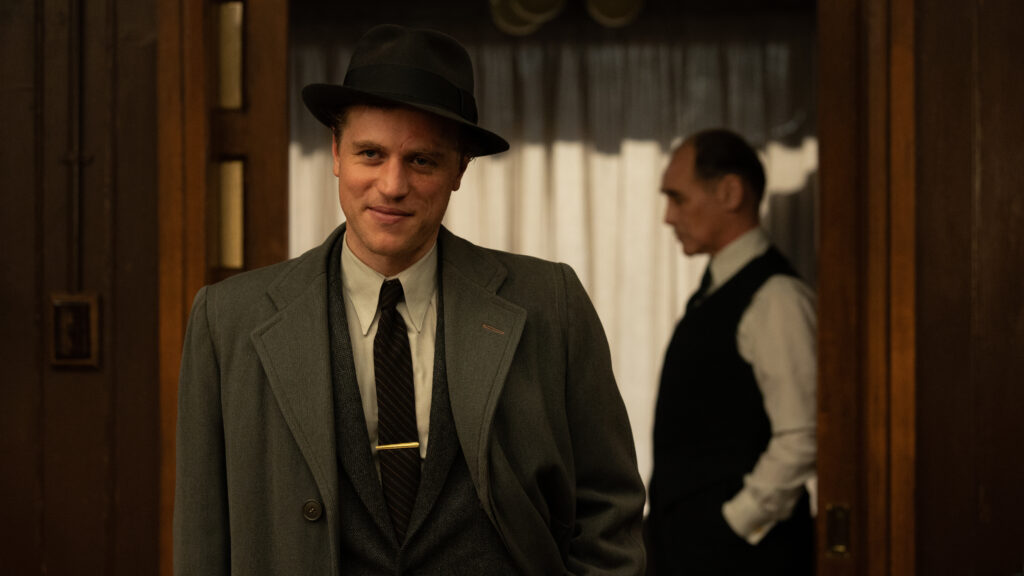
Johnny Flynn and Mark Rylance in “The Outfit” (Photo by Rob Youngson/Focus Features)

The suspenseful thriller “The Outfit” keeps viewers guessing about who are the heroes and who are the villains. It’s a well-crafted movie with a very talented cast that brings impressive energy to this unique story. If people ever say that good old-fashioned mystery films aren’t being made anymore, then point them in the direction of “The Outfit.” It pays homage to Alfred Hitchcock-influenced films of the mid-20th century while avoiding being a misguided, “stuck in a time warp” mess.

“The Outfit,” which takes place in 1956, is the feature-film directorial debut of Graham Moore. He won an Academy Award for Best Adapted Screenplay, for 2014’s “The Imitation Game,” another well-made movie about an intelligent British man who gets caught up in a web of lies and treacherous conspiracies. Moore co-wrote the “The Outfit” screenplay with Jonathan McClain.

Unlike the sprawling settings of “The Imitation Game,” the setting of “The Outfit” is contained entirely in one place: the small clothing shop of Leonard Burling (played by Mark Rylance), a British immigrant who has been living in Chicago for the past several years. It would be easy for viewers to assume that “The Outfit” was adapted from a stage play, but this movie has an original screenplay.

Leonard’s specialty is high-priced, custom-made men’s suits. He also does clothing repairs. He’s very meticulous and takes pride in his work. He’s also quick to tell people that he’s a cutter, not a tailor. As time goes on in the movie, viewers see that the movie’s title of “The Outfit” has a double meaning: the type of clothing that Leonard can make and the gang syndicate that causes the dangerous predicament that Leonard becomes involved with in this movie.

Leonard is a reclusive, middle-aged bachelor with no children. He lives alone in a back area of the shop. Leonard has one employee: a woman in her 20s named Mable (played by Zoey Deutch), who is the shop’s administrative assistant/receptionist. She has a perky personality and is very reliable. However, Mable is honest in telling Leonard that she doesn’t love his line of work and only has this job to make enough money to pay her bills. Her dream is to travel around the world, including go to Paris, a city that has a special place in her heart.

Leonard tells people that he moved from the United Kingdom to Chicago because the popularity of denim clothing made his bespoke line of work fairly obsolete in his native country, where he used to have a shop on London’s Savile Row. Leonard’s reason for immigrating to America doesn’t sound very plausible, because denim clothing is popular in the United States too. Leonard is very private and doesn’t divulge much about his personal life, although he mentions that he served in the British military during World War I.

Among the people who are Leonard’s loyal clients are some local Irish gangsters. Leonard stays out of the gang’s dirty dealings and doesn’t pass judgment. The wealthy Irish mob boss in the area is named Roy Boyle (played by Simon Russell Beale), who doesn’t appear until about halfway through the movie. Roy is grooming his only son Richie Boyle (played by Dylan O’Brien), who’s in his 20s or early 30s, to eventually take over the gang’s business.

However, Richie has a rival for this position of power: a cunning manipulator named Francis (played by Johnny Flynn), who’s about five to eight years older than Richie. Francis was orphaned at an early age and taken in by Roy as somewhat of a foster son. Francis is as cold and calculating as Richie is hot-headed and impulsive. Richie feels a lot of jealousy and resentment toward Francis, whom Richie suspects is his father Roy’s top choice to be Roy’s successor as the mob leader. Richie gripes to Leonard about Francis: “He not even Irish!”

Something happens during this story that forces Leonard to be caught in increasingly elaborate deceptions and traps involving a coveted surveillance tape and a missing person. Complicating matters, Francis and Mable are romantically involved with each other. All of the cast members give exemplary performances, but Rylance is the obvious standout because his Leonard character is the most complex. Nikki Amuka-Bird shares top billing in “The Outfit” as an enigmatic woman named Violet, but viewers should know that Violet gets very limited screen time (about five minutes) toward the end of the film. After a somewhat slow-paced start, “The Outfit” goes on a thrilling ride that keeps viewers on edge throughout this entire memorable mystery.

Focus Features released “The Outfit” in select U.S. cinemas on March 18, 2022. UPDATE: Peacock will premiere “The Outfit” on May 2, 2022.

2019 Tribeca Film Festival movie review: ‘Buffaloed’

May 1, 2019

by Carla Hay

Zoey Deutch in "Buffaloed"
Zoey Deutch in “Buffaloed” (Photo by Guy Godfree)

“Buffaloed”

Directed by Tanya Wexler

World premiere at the Tribeca Film Festival in New York City on April 27, 2019.

What’s an ambitious girl to do when she needs money to go to an Ivy League university but she can’t afford it? Turn to a life of crime, of course. That’s pretty much the story of Peg Dahl (manically played by Zoey Deutch) in the over-the-top comedy “Buffaloed.” The movie gets its name from Peg’s hometown of Buffalo, New York, where she was raised by a working-class, single mother named Kathy (played by Judy Greer), who doesn’t think Peg needs an Ivy League education to be a success. From an early age, Peg has had an obsession about escaping from Buffalo by attending an Ivy League school and becoming a rich and successful businessperson.

Peg’s dream starts to come true when she’s accepted into an Ivy League school, but she panics after her mother is turned down for financial aid. (Her mother supposedly makes too much money to qualify.) Peg presumably doesn’t have outstanding-enough grades to qualify for an academic scholarship either. And, of course, there would be no “Buffaloed” movie if Peg did what most people do when they can’t afford college tuition—take out a loan. So with no way to afford the tuition and with the deadline approaching to pay the tuition, Peg uses desperate measures and begins selling counterfeit tickets at Buffalo Bills games. Most movies at this point would have had Peg get away with the crime, head off to school, and continue to cook up schemes to pay for her tuition. But this is not that film.

Instead, Peg gets busted early on in the film, and she gets sentenced to 40 months in prison. Goodbye, Ivy League. One of the scenes that shows that “Buffaloed” is taking the campy, not-to-be-taken-seriously route is the chaotic environment of Peg’s trial, where the judge is eating sauce-covered Buffalo wings on the bench. When Peg gets out of prison, she is bitter, disillusioned and in debt. Her legal bills total $50,000, and being a criminal convicted of fraud has greatly reduced her chances of getting a decent job.

So let’s get this straight: Before she went to prison, Peg supposedly wasn’t able to afford an expensive Ivy League education, but she didn’t want to take out a student loan. Now she’s got $50,000 in legal bills because apparently she didn’t want to use a public defender, which is what you’re supposed to do if you can’t afford an expensive attorney. Right. Let’s move on.

Enter a character who opens a window of opportunity for Peg: Sal Scarpetta (played by “Buffaloed” screenwriter Brian Sacca, one of the film’s producers), who works for the town’s top debt-collection agency, which is hounding Peg to pay her debts. Peg and Sal first communicate over the phone when he calls her about her debt. Since the collection agency already knows about her ex-con background, and Peg finds out how much money she could be making if she worked there, it’s not long before she shows up at the agency and asks for a job.

Sal’s boss is Josh “Wizz” Wisnewski (played by Jai Courtney, hamming it up in the villain role), who runs the sleazy agency. Wizz is a sexist bully who’s reluctant to hire Peg in his aggressive, male-dominated environment. But through persistence, Peg convinces Wizz to hire her, and she makes a deal with him to erase all of her debt if she can become the company’s top debt-collector in one month.

Peg soon finds out that Wizz’s operation engages in many illegal practices, including “double-dipping,” a term used to keep billing someone for debt that has already been paid. Peg is so determined to become the top employee that she drives to Ohio to visit an elderly woman with a 20-year-debt (and Peg even brings cupcakes as part of her manipulation), because she figures that the old lady is a prime target for Peg to pull a double-dipping scam on her.

The rest of the movie veers off into a number of twists and turns, including Peg going to war with Wizz for reasons that won’t be spoiled in this review. It’s enough to say that Wizz’s “mob boss” mentality and use of extreme intimidation tactics are examples of the caricature-like silliness in this movie. Somehow, Peg’s mother Kathy, Peg’s brother JJ (played by Noah Reid) and Wizz’s brother Mitch (played by Nicholas Carella) get pulled into these shenanigans. There’s also a subplot where Peg gets romantically involved with the assistant district attorney who prosecuted her: Graham Feany (played by Jermaine Fowler), who knows she’s involved in illegal money-making schemes, but he looks the other way as long as she doesn’t tell him all the details.

“Buffaloed” director Tanya Wexler keeps a madcap pace throughout the movie that works in some areas and doesn’t work in others. Deutch (who is one of the film’s producers) takes on the role of Peg with admirable gusto. However, since Peg can’t seem to get out of Buffalo (something that’s she’s been wanting to do her whole life), and she gets caught early on for a felony crime, Peg is not as smart as the movie wants you to think she is. Unfortunately, the third act is such a mess that only a major rewrite could save the film.

The tone of “Buffaloed” is very uneven: It starts off as a dark comedy, and then turns giddy and almost sentimental in the end. “Buffaloed” could have had much better social commentary on the stresses of paying for college tuition and the extreme lengths people might go to get money for it. Instead, it devolves into an inconsistent whirling mix of under-developed characters and ill-conceived plotlines, just like an electric blender that turns a hodgepodge of ingredients into mush.

 UPDATE: Magnolia Pictures will release “Buffaloed” in select U.S. theaters and VOD on February 14, 2020.

Copyright 2017-2026 Culture Mix
CULTURE MIX